
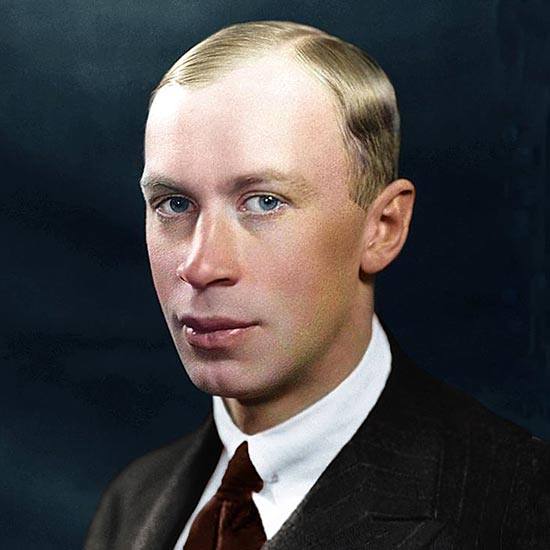
Sergei Prokofiev, The Iron Fist of Russian Music: Exploring a Life of Dissonance, Wit, and Uncompromising Genius
Have you ever heard a piece of music that sounds like a machine coming to life, with a driving, relentless rhythm and a kind of brutal, beautiful energy? That’s the sound of Sergei Prokofiev. He was a composer who, in a single lifetime, spanned the distance from the last days of Imperial Russia to the height of the Soviet Union. He was a man of immense contradictions: a child prodigy who was also a rebel, a witty and charming socialite who was also a deeply private and often difficult man. His music, like his life, is a fascinating puzzle, filled with a sound that is both abrasive and lyrical, both ironic and deeply emotional. He was not a composer who wanted to please the crowd; he was a revolutionary who believed that a composer’s job was to challenge, to provoke, and to lead the way to a new kind of sound. His work stands as one of the most powerful and complex artistic testaments to the triumph of the human spirit in the face of tyranny.
The Early Years: A Child Prodigy’s Rebellion
To understand the immense force of Prokofiev’s music, we must first look at his beginnings. His was not a typical path to musical greatness; it was a journey filled with a kind of restless, unyielding energy that would later become a defining characteristic of his art.
A Childhood Shaped by Music and a Fierce Independence
Born in 1891 in the village of Sontsovka in Ukraine, Prokofiev was a child prodigy who began piano lessons at the age of three. His mother was his first teacher, and she was a brilliant pianist who was a great influence on his early life. At the age of five, he began composing his own works, and by the age of 13, he had already written four operas and a symphony. He was a child of immense talent, a young man who was not content to simply play the works of others; he had to create his own.
The Young Composer’s Bold Experiments
Prokofiev’s early works were filled with a kind of youthful audacity. He was a composer who was not afraid to break the rules, to experiment with dissonance, and to write a music that was bold, new, and often shocking. He had a profound love for the piano, and his early works for the instrument were filled with a kind of percussive energy and a rhythmic drive that would later become a hallmark of his style.
A Troubled Period at the St. Petersburg Conservatory
In 1904, at the age of 13, he was accepted into the St. Petersburg Conservatory, where he studied with some of the greatest teachers in Russia. But his time at the conservatory was a difficult one. He was a brilliant student, but he was also a rebel, a young man who was not content to simply follow the rules. He often clashed with his teachers, who he felt were too old-fashioned and too conservative. He was a young composer who was in a hurry, a man who believed that the music of the past was dead and that it was time to create a new one.
The Musical Revolutionary’s First Clashes
He was seen as a kind of enfant terrible, a young rebel who was not afraid to challenge the old guard. He was a man who, in his youth, had already started to wage a war against the established musical traditions of his time. This early period of rebellion was a formative one. It instilled in him a kind of fierce independence, a willingness to be different, and a profound conviction that his own artistic voice was the only one that mattered.
Prokofiev’s Style: The Shock of the New
So, what is it that makes a piece of Prokofiev’s music so unmistakably his? It’s a unique and brilliant combination of four different artistic ideas that he himself famously described as the four pillars of his art.
The Four Pillars of His Art
Prokofiev believed that his music was built on four different pillars: classicism, modernism, lyricism, and motorism. Classicism was his love for the grand forms and the clear, elegant structures of the classical era. Modernism was his love for the dissonant, the shocking, and the experimental. Lyricism was his love for a long, beautiful, and emotionally profound melody. And motorism was his love for a driving, relentless, and almost mechanical rhythm.
Classicism, Modernism, Lyricism, and Motorism
This combination of four seemingly different artistic ideas is what gives his music its unique and brilliant voice. He was a composer who could, in a single piece, move from a beautiful, lyrical melody to a brutal, dissonant chord, and from a driving, relentless rhythm to a clear, elegant classical form. It was a style that was both complex and direct, both challenging and beautiful, and it was a style that was entirely his own.
The Use of Rhythm and Percussion
One of the most striking features of his style is his use of rhythm and percussion. He was a composer who believed that rhythm was the lifeblood of music, and he used it with a kind of raw, explosive energy that was new and shocking for his time. His music is filled with a sense of driving, relentless forward motion, a feeling of a great machine coming to life.
A Sound That is Both Mechanical and Human
His music is a perfect example of a sound that is both mechanical and human. It’s a sound that is filled with a kind of cold, metallic energy, but it is also filled with a deep, emotional honesty. He was a composer who, with his hands, could make a machine sing, a man who, with his music, was able to explore the beautiful, and often terrifying, contradictions of modern life.
The Grand Escape: A Decade of Wanderlust and Experimentation
After the Russian Revolution, Prokofiev, like many other Russian artists, decided to leave his homeland. He was a man who, in his heart, was an outsider, and he felt that he could not thrive in a world that was becoming more and more controlled by the state.
A Farewell to Russia
In 1918, Prokofiev, with a passport and a letter of recommendation from the Soviet commissar of education, left Russia. He traveled through Siberia, to Japan, and then to the United States. He was a man who was, for the first time in his life, an artist in exile, a man who was forced to make his own way in a new and different world.
The Life of an Exiled Artist
He spent the next two decades of his life in Europe and the United States, a period of immense creative output and personal struggle. He was a celebrity, a man who was revered for his brilliant piano playing and his daring, unconventional compositions. But he was also a man who was deeply lonely, a man who longed for his homeland and for the kind of creative freedom that he had known in his youth.
The Ballets and Operas of the Roaring Twenties
During this period, he wrote some of his most famous and most enduring works. He wrote his opera, The Love for Three Oranges, a witty and satirical work that was a brilliant example of his love for irony and his gift for melody. He also wrote his ballet, The Prodigal Son, a beautiful and emotionally profound work that was a perfect example of his love for a long, lyrical melody.
The Love for Three Oranges and The Prodigal Son
These works were a perfect reflection of his time in exile. They were filled with a sense of playful wit, a feeling of a man who was having fun with his art. But they were also filled with a sense of deep, unyielding melancholy, a feeling of a man who was, in his heart, a stranger in a strange land.
The Return to the Lion’s Den: A Life of Perilous Compromise
In the mid-1930s, Prokofiev made a decision that would change the course of his life and his career: he decided to return to the Soviet Union.
The Lure of the Homeland
The reasons for his return are complex. He was, by all accounts, deeply homesick. He was a man who, in his heart, was a Russian, and he longed for his homeland, for its people, and for its soul. He was also, perhaps, a little naive. He believed that the Soviet Union, under the leadership of Stalin, was a place that was now more open to artists. He believed that he could be a great artist in his homeland, a man who could, in a sense, have his cake and eat it too.
A Naïve Return and a Dark Reality
His return was a terrible mistake. The Soviet Union was a different place than the one he had left. It was a place that was filled with political purges, with a climate of fear, and with a state-controlled artistic establishment that demanded that all art serve the cause of the revolution. He was a man who had walked back into the lion’s den, and he would spend the rest of his life paying a terrible price for his decision. .
The Symphonies of a Troubled Soul
His later symphonies, in particular, are a perfect example of this duality. They are, on the surface, grand, epic, and celebratory works that were praised by the state. But underneath the surface, they are filled with a sense of profound irony, of deep, unyielding sorrow, and of a kind of quiet, defiant rage. He was a man who was forced to write music that was both public and private, a man who, with every note he wrote, was telling a secret.
A Symphony That is Both Grand and Melancholy
His Symphony No. 5, in particular, is a masterpiece of this duality. The symphony is, on the surface, a grand and glorious celebration of the Soviet spirit. But if you listen closely, you can hear a different story, a story of a man who was, in his heart, a prisoner, a man who was forced to write a music that was a lie.
The Masterpieces: A Legacy of Unforgettable Works
While his life was a journey of immense joy and profound sorrow, Prokofiev’s masterpieces are a testament to his enduring genius.
Romeo and Juliet: A Tragedy in Dance
His ballet Romeo and Juliet is one of the greatest works of the 20th century. It is a masterpiece of dramatic and musical storytelling, a work that, with its stunning orchestration and its powerful melodies, tells a timeless story of love, betrayal, and a tragic end. The ballet is a perfect example of his love for a long, lyrical melody and his ability to tell a story with a sense of profound emotional honesty.
The Montagues and Capulets and The Dance of the Knights
The ballet is filled with a series of unforgettable moments. The famous “Dance of the Knights”, which represents the clash between the two families, is a perfect example of his love for a driving, relentless rhythm and a kind of brutal, beautiful energy. The love theme, which is a long, lyrical melody, is a perfect example of his love for a beautiful, emotionally profound sound.
Peter and the Wolf: A Children’s Classic
His symphonic fairy tale, Peter and the Wolf, is perhaps his most famous work. It is a brilliant and charming piece of music that is a perfect example of his love for a simple, clear, and elegant melody. The work, which tells the story of a young boy who, with his friends, captures a dangerous wolf, is a perfect example of his love for a story, and his love for a sense of playful wit.
A Symphony for Young Ears
The work, with its simple, clear melody and its brilliant use of a different instrument for each character, is a perfect introduction to the world of classical music. It is a work that shows a composer who, despite his love for dissonance and his love for a brutal, beautiful sound, was also a man who was able to write a music that was filled with a sense of pure joy and a sense of a quiet, childlike wonder.
Prokofiev’s Final Years and Enduring Legacy
Prokofiev died on March 5, 1953, the very same day as Joseph Stalin. For many people, it was a symbolic end to a life that had been defined by a constant battle with the very system that had, in a sense, both created and destroyed him.
A Final, Haunting Dissonance
His final works, including his Symphony No. 7, are filled with a sense of deep, unyielding sorrow, a kind of quiet, haunting melancholy that is a perfect reflection of a man who was, in his heart, a prisoner. The final notes of his last symphony are filled with a sense of a quiet, fading despair, a perfect end to a life that had been filled with so much triumph and so much tragedy.
A Composer Who Spoke for a Silent Nation
Prokofiev was a composer who, in a sense, spoke for a silent nation. He wrote music that was not just his own private confession; it was a collective cry of a nation that was living under a dark and terrible cloud. He was a man who, with a single, ironic melody, could tell a whole world of secrets.
Conclusion: The Unconquerable Spirit of a Musical Rebel
Sergei Prokofiev was a composer who, in a single lifetime, lived through a revolution and a tyranny, and his music is a testament to the idea that a man who is forced to live with two faces can, in the end, produce an art that is more truthful and more profound than a man who has only one. He was a composer who, with his hands, could make a machine sing, a man who, with his music, was able to explore the beautiful, and often terrifying, contradictions of modern life. His legacy is an unmistakable echo of a tortured genius, a voice that speaks to us across the years, a voice that tells us that the struggle for truth is a struggle that is always, and forever, worth fighting for.
Frequently Asked Questions (FAQs)
1. What were the four “pillars” of Prokofiev’s music?
Prokofiev famously described his style as being built on four “pillars”: classicism, which was his love for classical forms; modernism, which was his love for dissonance and experimentation; lyricism, which was his love for beautiful, emotionally profound melodies; and motorism, which was his love for a driving, relentless rhythm.
2. Why is “Peter and the Wolf” so popular?
Peter and the Wolf is popular because it is a brilliant and charming piece of music that is a perfect introduction to the world of classical music for children. Each character in the story is represented by a different instrument in the orchestra, which helps children to learn about the different instruments and their unique sounds.
3. Why did Prokofiev return to the Soviet Union?
Prokofiev returned to the Soviet Union in the mid-1930s for several reasons. He was deeply homesick for his homeland, and he was also, perhaps, a little naive. He believed that the Soviet Union, under the leadership of Stalin, was a place that was more open to artists than it had been in the past.
4. What is the significance of the ballet “Romeo and Juliet”?
Romeo and Juliet is one of the most famous ballets of the 20th century. It is a masterpiece of dramatic and musical storytelling, with a score that is filled with some of the most beautiful and emotionally powerful music ever written. The ballet’s music has become a classic in its own right, and it is a perfect example of Prokofiev’s unique blend of lyricism and dramatic flair.
5. How did Prokofiev die?
Prokofiev died on March 5, 1953, the very same day as Joseph Stalin. His death was largely overshadowed by Stalin’s, and he was, in a sense, a man who was a prisoner even in death.