
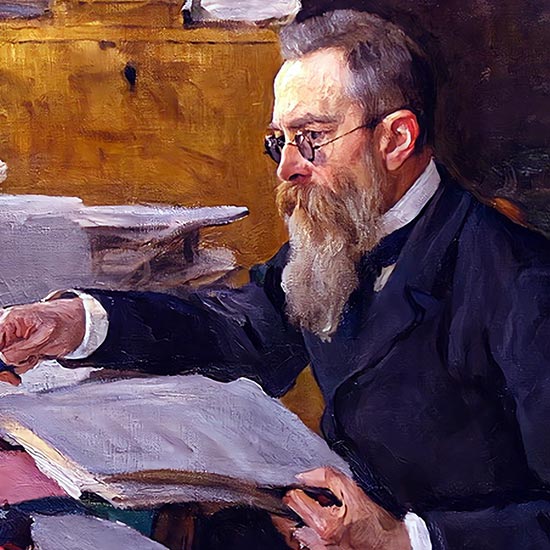
Nikolai Rimsky Korsakov, The Master of the Magical: A Composer’s Journey Through Sound and Color
If you’ve ever felt transported to a land of magic and myth by a piece of music, with vibrant colors and vivid scenes unfolding in your mind, chances are you were listening to Nikolai Rimsky Korsakov. He wasn’t just a composer; he was a musical sorcerer, a man who, with his masterful command of the orchestra, could conjure up entire worlds of sound. His music is like a brilliant painting, filled with a lush, vibrant palette of colors and a sense of fantastical storytelling. He was a central figure in the movement to create a distinctly Russian classical music, a man who, alongside his contemporaries, used the rich traditions of Russian folklore and history to forge a new and powerful artistic voice. From the salty spray of the sea to the mystical tales of the Orient, his music is a journey into a world of enchantment, a world where anything is possible, and every note is a brushstroke of pure magic.
The Early Years: From Naval Cadet to Musical Innovator
To understand the unique voice of Rimsky Korsakov, you have to look at the unlikely beginnings of his career. His path to musical greatness was not a straight line; it was a winding journey that began in the most unexpected of places.
A Childhood Shaped by the Sea and a Love for Music
Born in 1844, Rimsky Korsakov came from a family of Russian aristocrats with a long history of military service. His older brother was a famous naval officer, and it was expected that young Nikolai would follow in his footsteps. From a young age, he was fascinated by the sea, a love that would later find its way into some of his most famous works. But he was also deeply in love with music. He began piano lessons at the age of six, and he showed a remarkable talent, but his passion for music was seen as a hobby, a pastime, not a profession.
The Unlikely Path to Musical Greatness
At the age of 12, he was enrolled in the Naval Cadet Corps in St. Petersburg. He spent the next six years of his life training to be a naval officer. But while he was learning the ways of the sea, he was also pursuing his love for music. He continued his piano lessons and he began to immerse himself in the world of classical music. He was, in a sense, a man of two worlds, a man who was torn between the duty of a military life and the passion of an artistic one. This tension between his professional life and his artistic one would later become a defining characteristic of his career.
The Mighty Handful: A Brotherhood of Russian Composers
In 1861, while still in the Naval Cadet Corps, he had a meeting that would change his life: he met the composer Mily Balakirev. Balakirev was the leader of a group of young, talented composers who were committed to creating a distinctly Russian classical music. The group, which became known as “The Mighty Handful” or “The Five,” included Balakirev, Rimsky Korsakov, César Cui, Modest Mussorgsky, and Alexander Borodin.
The Push for a Distinctly Russian Sound
The goal of this brotherhood was to move away from the European, Italianate traditions that dominated Russian classical music and to create a new, nationalistic voice. They used themes from Russian history, from Russian folk songs, and from Russian fairy tales to create a music that was bold, new, and unmistakably Russian. Rimsky Korsakov, with his love of color and his gift for melody, was a central figure in this movement, and his work became a perfect example of their artistic ideals.
The Rimsky Korsakov Style: A Symphony of Enchantment
So, what is it that makes a piece of Rimsky Korsakov’s music so magical? It’s a unique combination of his masterful orchestration, his love for storytelling, and his ability to create a sense of wonder and enchantment.
The Art of Orchestration: A Painter of Sound
Rimsky-Korsakov was a master of orchestration. He had an almost supernatural ability to use the different instruments of the orchestra to create a vast, complex, and beautiful tapestry of sound. He was, in a sense, a painter of sound, a man who used the brass, the woodwinds, and the strings as a palette to create a world of vibrant color. His music is filled with a sense of shimmering, otherworldly light, a sound that is both deeply emotional and incredibly beautiful.
The Use of Color and Timbre
His use of timbre (the unique sound quality of each instrument) was particularly brilliant. He knew how to make a flute sound like a bird, a clarinet sound like a lament, and a trumpet sound like a blast of glory. He was a composer who knew how to use every instrument to its full potential, and his orchestrations were so brilliant that they inspired a new generation of composers, including his most famous student, Igor Stravinsky. .
The Influence of Russian Folklore and Fairy Tales
A huge part of his unique style was his love for Russian folklore and fairy tales. He was a composer who believed that music should tell a story, and his music is filled with a sense of narrative and drama. He was fascinated by the world of magic and myth, and he used this fascination to create a music that was both deeply personal and universally enchanting.
The World of Magic and Myth in Music
His operas and orchestral works are filled with a cast of magical characters: a beautiful, otherworldly princess, a golden rooster that can see the future, and a great storyteller who can captivate a king with her tales. He was a composer who, in his own way, was a storyteller, a man who, with a single melody, could transport you to a world of talking birds, enchanted forests, and beautiful, magical princesses.
The Masterpieces: A Legacy of Unforgettable Works
While he wrote a vast body of work, it is his three most famous works that have cemented his place in the pantheon of great composers. They are a legacy of pure musical magic.
Scheherazade: The Ocean and the Storyteller
His most famous work is Scheherazade, a symphonic suite that is based on the stories of One Thousand and One Nights. The music is a perfect example of his love for color and his gift for storytelling. It is filled with a sense of dramatic flair, a feeling of wonder and enchantment, and a sound that is both grand and majestic. The music is a journey through a world of adventure, of love, of betrayal, and of magic. It is, in a sense, a musical adaptation of the power of a story to save a life.
The Timeless Tale in Musical Form
The suite is a masterpiece of orchestration. Rimsky Korsakov used a solo violin to represent the voice of the storyteller, Scheherazade, and he used the full orchestra to represent the different stories that she tells. The music is filled with a sense of exotic mystery, with a sound that is both deeply lyrical and overwhelmingly powerful. It is a work that, with its masterful use of rhythm and melody, tells a timeless tale in a new and unforgettable way.
The Golden Cockerel: Satire and Fantasy
His opera The Golden Cockerel is a very different kind of work. It is a brilliant and biting satire of the Russian monarchy. The opera, with its colorful characters and its witty, sarcastic humor, is a perfect example of his use of music to tell a political story. The opera, which was banned by the Russian authorities, was a brave and defiant act of artistic expression.
A Political Fable in a Fairy-Tale Setting
The opera is a perfect fusion of fairy-tale magic and political commentary. He uses the world of myth and magic to tell a story that is deeply rooted in the political realities of his time. The opera is a masterpiece of irony and wit, a work that shows a composer who was not just a musical magician but a man who was deeply engaged with the world around him.
Russian Easter Overture: A Celebration of Faith
His Russian Easter Overture is a very different kind of work. It is a grand, celebratory work that is filled with a sense of faith and spiritual awe. The overture is a musical representation of the great spiritual journey of the Russian Orthodox Church. It is filled with the deep, resonant sounds of the Russian bells, the soaring melodies of the church choirs, and a sense of profound spiritual awakening. It is a work that shows a composer who was not just a master of the magical but a man who was also deeply in touch with the spiritual traditions of his homeland.
The Teacher and Mentor: Shaping the Next Generation
Rimsky Korsakov was not just a composer; he was also a legendary teacher, a man who, with his unique teaching style, helped to shape the next generation of Russian composers.
The Professor Who Taught a Revolution
In 1871, he was offered a professorship at the St. Petersburg Conservatory. At first, he was hesitant. He had no formal training in composition or music theory. He was a self-taught genius, and he had learned everything he knew by doing. But he accepted the position, and he quickly became one of the most respected and influential teachers in the history of music.
The Unconventional Teacher
He was an unconventional teacher. He was not a man who was interested in rules and regulations. He was a man who was interested in a student’s unique voice, in their creative spirit. He taught his students not just how to compose, but how to find their own voice, how to be true to their own artistic vision. He was, in a sense, a teacher who taught a revolution, a man who, with his students, helped to change the course of music history.
A Mentor to the Greats: Stravinsky and Prokofiev
His most famous student was Igor Stravinsky. Stravinsky, who was a young, brilliant and ambitious composer, was captivated by Rimsky-Korsakov’s genius. He took him on as a private student, and he spent the next few years of his life learning the secrets of orchestration and the art of composing for the orchestra. Stravinsky would later say that his time with Rimsky Korsakov was the most important period of his life, a time that shaped his own unique musical voice. He also taught other great composers like Sergei Prokofiev, further solidifying his place as a key figure in musical education.
The Political Artist: Conflict with the State
Like many other Russian artists of his time, Rimsky-Korsakov found himself in a constant struggle with the state. He was a man who believed in artistic freedom, and he was not afraid to use his art to challenge the authorities.
The Professor of Rebellion
In 1905, during the first Russian Revolution, he was a vocal supporter of the students who were protesting against the authorities. He wrote a letter to the director of the conservatory, condemning the director’s actions, and he was promptly fired. He was, in a sense, a professor of rebellion, a man who was willing to risk his career and his reputation for the cause of artistic and political freedom.
A Voice for Artistic Freedom
His firing caused a huge scandal, and many other professors resigned in protest. The incident cemented his reputation as a man of great moral and artistic integrity. He was a man who, in a world of political oppression, was willing to use his voice, and his art, to speak for the cause of freedom.
Conclusion: The Enduring Magic of a Musical Master
Nikolai Rimsky-Korsakov was a man of immense talent and profound influence. He was a composer who, with his mastery of the orchestra, could create entire worlds of sound and color. He was a teacher who, with his unique artistic vision, helped to shape a new generation of composers. He was a man who, in a world of political turmoil, was an unwavering voice for artistic freedom. His music is a permanent monument to a man who, with his hands, could create a world of magic, a world of enchantment, and a world of pure, unadulterated beauty. His work reminds us that music is not just about sound; it is about a story, it is about a feeling, and it is about the endless, magical possibilities of the human imagination.
Frequently Asked Questions (FAQs)
1. What was “The Mighty Handful” and what was their goal?
“The Mighty Handful,” also known as “The Five,” was a group of five Russian composers in the 19th century who were committed to creating a distinctly Russian classical music. Their goal was to move away from the European traditions and to create a new, nationalistic voice by using themes from Russian history, folklore, and literature.
2. Why is Rimsky Korsakov considered a master of orchestration?
Rimsky Korsakov is considered a master of orchestration because of his exceptional ability to use the different instruments of the orchestra to create a vast, complex, and colorful tapestry of sound. He had a deep understanding of the unique sound quality of each instrument and he used this knowledge to create a sense of vivid imagery and dramatic flair in his works.
3. What is the story behind the symphonic suite “Scheherazade”?
“Scheherazade” is a symphonic suite by Rimsky Korsakov that is based on the stories of One Thousand and One Nights. The music tells the story of a beautiful storyteller who must captivate a king with her tales in order to save her life. The suite is a masterpiece of musical storytelling, with each movement representing a different story from the collection.
4. How did Rimsky Korsakov influence Igor Stravinsky?
Rimsky Korsakov had a profound influence on Igor Stravinsky, who was his private student for several years. He taught Stravinsky the art of orchestration and the importance of a clear and vivid musical voice. Stravinsky would later say that his time with Rimsky Korsakov was one of the most important periods of his life, a time that shaped his own unique musical voice.
5. What role did Rimsky Korsakov play in the 1905 Russian Revolution?
In the 1905 Russian Revolution, Rimsky Korsakov was a vocal supporter of the students who were protesting against the authorities. He wrote a letter to the director of the St. Petersburg Conservatory, condemning the director’s actions, and he was promptly fired. His actions cemented his reputation as a man of great moral and artistic integrity.