
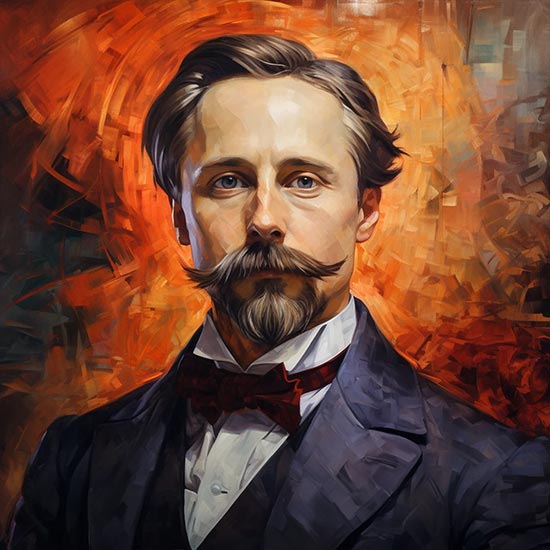
Alexander Scriabin, The Mystic of the Piano: A Journey into a World of Synesthesia, Philosophy, and Unprecedented Sound
Have you ever listened to a piece of music and felt like it was not just a sound, but a color, a smell, or even a feeling of light and warmth? If so, you’ve touched on a world that Alexander Scriabin lived in every single day. He wasn’t just a composer; he was a mystic, a philosopher, and a visionary who believed that music was a force that could change the very fabric of reality. He was a man who saw sounds as colors, a man who, in his quest to unite all of the senses, created a music that was unlike anything the world had ever heard. He was a composer who, in a single lifetime, moved from a sound that was deeply rooted in the traditions of the 19th century to a sound that was so radical, so new, and so personal that it feels like it came from another dimension. His music is a journey into the inner self, a world of beautiful melodies, of jarring dissonance, and of an unyielding spiritual passion.
The Early Years: A Prodigy’s Journey into a World of Dissonance
To understand the radical nature of Scriabin’s later work, you have to look at his beginnings. His was a journey that started in the quiet, conservative world of 19th-century Russia and took him on a path that no other composer had ever dared to travel.
A Childhood Shaped by Solitude and Musical Genius
Born in 1872, Scriabin’s childhood was marked by tragedy and a profound sense of solitude. His mother died when he was just one year old, and his father, a diplomat, was often away on assignment. He was raised by his aunt and grandmother, who were both cultured and loving women, but his childhood was, in a sense, a lonely one. He was a delicate and sensitive boy who found his greatest comfort and his greatest joy in the world of music. From a very young age, it was clear that he had a profound and undeniable musical talent.
From a Military School to the Moscow Conservatory
At the age of 10, he was sent to a military cadet school, a place that was a terrible fit for his sensitive and artistic nature. But even in this rigid and often brutal environment, his passion for music never wavered. He would spend every spare moment playing the piano and composing. His talent was so great that he was eventually accepted into the prestigious Moscow Conservatory, where he studied with some of the greatest teachers in Russia, including Sergei Taneyev, a student of Tchaikovsky. It was here that his musical talent truly blossomed.
The Influence of Chopin and Liszt
Scriabin’s early works are deeply influenced by the great romantic composers of the 19th century, particularly Frédéric Chopin and Franz Liszt. He was a brilliant pianist, and his early works for the piano, with their beautiful, lyrical melodies and their emotional depth, are a perfect example of his love for the romantic tradition. He was a composer who, in his youth, was a master of the classical and romantic forms, a man who, in a sense, had mastered the language of the past before he set out to invent his own.
The Early Works and the Melodic Genius
His early piano works, like the Preludes and the Études, are filled with a sense of immense beauty and a feeling of deep, unyielding passion. They are a testament to his melodic genius and his profound love for the piano. They are a world away from the dissonant, mystical works of his later years, and they are a perfect example of a composer who was, in his heart, a true romantic.
Scriabin’s Style: A Revolution of Harmony and Expression
In the early 1900s, Scriabin began to move away from the romantic traditions of his youth. He was a man who, in his mind, had already mastered the language of the past, and he was now in a quest to invent a new one.
A Radical Departure from Tradition
Scriabin’s mature style is a radical departure from anything that had come before. He began to move away from the traditional rules of harmony and tonality. He began to write a music that was filled with a sense of immense chromaticism, a music that was constantly shifting and moving, a music that was, in a sense, always on the edge of a great, a beautiful, and a terrible breakdown.
The Quest for a New Language of Sound
He was a composer who believed that music should not be about a simple, easy melody. He believed that music should be about a profound, spiritual journey. He was a man who, in his mind, was on a quest to find a new language of sound, a language that could express the complex and often terrifying truths of the inner world. This quest for a new language of sound was a lonely one. He was a composer who was so far ahead of his time that many of his contemporaries simply did not understand his work.
The Mystic Chord: A Key to Another Dimension
One of the most famous and most brilliant features of Scriabin’s mature style is his use of the “Mystic Chord.” The chord, which is filled with a sense of immense dissonance, is not a harmony that is meant to be resolved. It is a harmony that is meant to be a kind of key, a way of opening up a door to another dimension. He believed that the chord was a kind of spiritual portal, a way of exploring the complex and often terrifying truths of the inner self.
A Harmony That Is Both Dissonant and Beautiful
The chord is a perfect example of his unique artistic vision. It is a harmony that is both jarring and beautiful, a sound that is both dissonant and emotionally profound. It is a perfect example of a composer who, in his quest for a new language of sound, was able to create a music that was both a challenge to the mind and a profound experience for the soul.
Synesthesia: The Fusion of Color and Sound
Scriabin’s quest for a new kind of musical expression was also a deeply personal one. He was a man who experienced a rare neurological condition known as synesthesia, a condition that caused him to see sounds as colors.
A Composer Who Could See Music
Scriabin’s synesthesia was not just a side note of his work; it was a central, defining part of his artistic vision. He believed that the different musical keys corresponded to different colors, and he developed a complex and beautiful color system for his music. For him, a C major chord was a beautiful, fiery red, and an F-sharp major chord was a kind of dark, shimmering blue. He was, in a sense, a man who could see music, a man who believed that music was a visual art. .
Prometheus, The Poem of Fire: A Symphony of Light and Color
His most famous work that is a perfect example of his synesthesia is his symphony, Prometheus, The Poem of Fire. The symphony, which is a masterpiece of orchestration and a brilliant example of his mature style, was written with a complex light show in mind. He wrote a specific part for a color organ, an instrument that would project a different color onto a screen for each musical chord. He believed that the symphony was not just a sound, but a total experience, a symphony of light and color and sound that was meant to be a kind of spiritual ritual.
The Spiritual Journey: From Philosophy to the Mysterium
Scriabin’s artistic journey was also a deeply philosophical one. He was a man who believed that art was not just about beauty; it was about a profound, spiritual journey. He was a great admirer of the Russian mystic Helena Blavatsky, and he was deeply influenced by her ideas about theosophy, a philosophy that believed in the spiritual union of all things. He was a composer who believed that his art was a way of exploring the deepest truths of the universe.
A Composer Who Believed in the Power of Art to Change the World
Scriabin believed that his music had the power to change the world. He believed that his art was a force for good, a way of bringing all of humanity together in a single, great, and beautiful artistic act. He had a grand, utopian vision of a final work, a masterpiece that would be a kind of artistic culmination of his entire life’s work.
The Later Works: A Legacy of Unprecedented Sound
Scriabin’s final years were a period of immense creative output and a constant, unyielding quest for a new artistic language. His later works for the piano are some of the most complex, most brilliant, and most emotionally profound works ever written for the instrument.
The Piano Sonatas: A Journey into the Inner Self
His later piano sonatas, in particular, are a perfect example of his mature style. They are not just musical pieces; they are a kind of spiritual journey, a journey into the deepest and most complex parts of the inner self. His Sonata No. 7, known as the “White Mass,” is a work of immense spiritual power. It is filled with a sense of light, a feeling of purity, and a profound sense of a spiritual awakening.
The Black Mass and The White Mass
His Sonata No. 9, known as the “Black Mass,” is a very different kind of work. It is a work of immense darkness, of a sense of a spiritual possession, and a feeling of a profound, and often terrifying, inner conflict. These two works are a perfect example of his duality: a man who, with his art, was able to explore both the great spiritual light and the deep, terrible darkness of the human soul.
The Final Years: A Legacy of Mysticism and Unfinished Dreams
In his final years, Scriabin became obsessed with a single, grand, and utopian idea: a final work that he called the Mysterium. The work was meant to be a multi-day event that would be a culmination of all of the arts. It would be performed in the Himalayas, and it would be a kind of spiritual ritual that would bring all of humanity together and lead to a new, better world.
The Unfinished Mysterium and a Final Act of Creation
Scriabin died in 1915, at the age of 43, leaving the Mysterium unfinished. His death was a terrible tragedy. It was a premature end to a life that had been filled with a kind of restless, unyielding energy, a life that was always on the quest for something new, something better, and something more. His legacy is a permanent reminder of the power of a single, brilliant artistic vision.
Scriabin’s Enduring Legacy
Scriabin’s legacy is one of the most powerful and enduring in all of music history. He was a composer who, in a single lifetime, moved from a sound that was deeply rooted in the past to a sound that was so far ahead of its time that we are, even today, still trying to catch up.
The Unsung Hero of Modernism
For many years, Scriabin was seen as a kind of oddity, a footnote in the history of music. He was too personal, too mystical, and too far ahead of his time to be fully appreciated. But in recent years, his legacy has been rediscovered, and he is now, rightfully, seen as one of the unsung heroes of modernism, a composer who, with his daring experiments, paved the way for the great composers of the 20th century.
An Influence on the 20th Century and Beyond
His influence on composers like Arnold Schoenberg and Igor Stravinsky was profound. They saw him as a man who, in his work, had shown them a new way forward, a new way of thinking about harmony, and a new way of thinking about the very nature of music. He was a composer who, in a single life, changed the way we listen to music.
Conclusion: The Unmistakable Echo of a Musical Visionary
Alexander Scriabin was a composer who, in a single lifetime, lived in two different worlds: the world of traditional music and the world of his own unique, mystical artistic vision. He was a man who was obsessed with a single, grand idea: that music was a force for spiritual and personal transformation. He was a composer who, with his hands, could create a music that was both beautiful and terrifying, both familiar and completely new. His legacy is an unmistakable echo of a musical visionary, a voice that speaks to us across the years, a voice that tells us that the greatest art is not always the most conventional, but the most daring, and the most true to its own soul.
Frequently Asked Questions (FAQs)
1. What is synesthesia, and how did it affect Scriabin’s music?
Synesthesia is a rare neurological condition that causes a person to experience one sense through another. For Scriabin, it meant he saw sounds as colors. This directly influenced his music, leading him to develop a color system for his compositions, most famously in his work Prometheus, The Poem of Fire, which was intended to be performed with a light show.
2. What is the “Mystic Chord”?
The “Mystic Chord” is a complex, six-note harmonic structure that Scriabin used in his later works. It is not a traditional chord that resolves to a clear tonic. Instead, it functions as a kind of key to a new harmonic and expressive dimension. He believed the chord was a spiritual portal, a way of exploring the deepest truths of the universe.
3. How did Scriabin’s early works differ from his later works?
Scriabin’s early works were deeply influenced by the romantic composers of the 19th century, particularly Chopin and Liszt. These works are filled with beautiful, lyrical melodies and traditional harmonies. His later works, however, are a radical departure from tradition, filled with a sense of dissonance, chromaticism, and a unique harmonic language that was entirely his own.
4. What was the “Mysterium”?
The Mysterium was Scriabin’s final, grand, and utopian artistic vision. It was intended to be a multi-day event in the Himalayas that would be a culmination of all of the arts. He believed that the work would unite all of humanity in a single, great, and beautiful artistic act, leading to a new, better world. He died before he could finish it.
5. What is the significance of the “White Mass” and “Black Mass” sonatas?
Scriabin’s Piano Sonata No. 7, known as the “White Mass,” is a work of immense spiritual power, filled with a sense of light and a feeling of purity. His Piano Sonata No. 9, known as the “Black Mass,” is a work of immense darkness, filled with a sense of a spiritual possession and a profound inner conflict. These two works are a perfect example of his duality: his ability to explore both the great spiritual light and the deep, terrible darkness of the human soul.