Boris Pasternak, The Poet of a Revolution: Exploring the Life and Legacy of a Russian Master
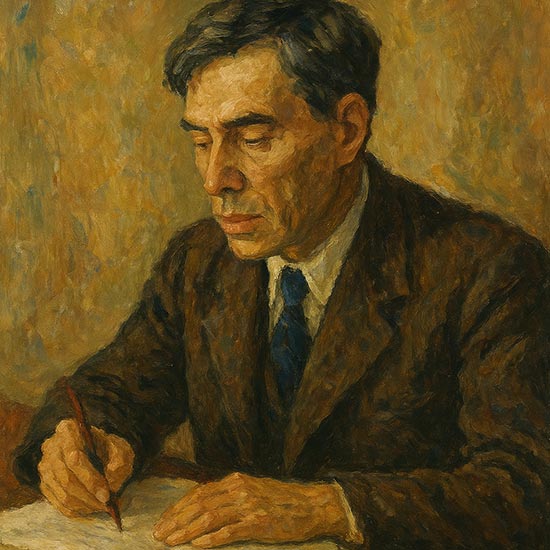
Boris Pasternak was a writer who refused to be defined by the storm of history that raged around him. He was born into a world of art and beauty, only to have his life consumed by the brutality of war and revolution. Yet, he never fully abandoned his artistic ideals for political dogmas. While other writers either embraced the new Soviet order or fled into exile, Pasternak chose a lonelier, more dangerous path: he stayed and he wrote. He was a poet of profound lyrical depth, a master of metaphor, and a quiet, unyielding voice of spiritual freedom in a society that demanded conformity. He is remembered not just for his monumental novel, Doctor Zhivago, but for his courageous refusal to let his art be a servant of the state. He was a man who, like his most famous character, believed in the quiet power of love, art, and nature to triumph over the chaos and cruelty of the outside world.
A Life Steeped in Art and Tumult
To understand the unique voice of Boris Pasternak, we need to look at the world he was born into. It was a world of immense cultural and intellectual ferment, a stark contrast to the political turmoil that would later consume his life.
The Artist’s Son: A Creative Upbringing
Born in Moscow in 1890, Pasternak was the son of two artists. His father, Leonid Pasternak, was a renowned post-Impressionist painter and a professor at the Moscow School of Painting. He was a personal friend of Leo Tolstoy, and the young Boris grew up in an environment where literary and artistic giants were a regular presence. His mother, Rosalia Kaufman, was a brilliant concert pianist. He spent his childhood surrounded by music, literature, and art. This vibrant, creative atmosphere instilled in him a love for beauty and a sensitivity to the world that would become the hallmark of his poetry.
A World of Music and Painting
Growing up, Pasternak was deeply drawn to music, and for a time, he even considered a career as a composer. The influence of music on his poetry is clear; his poems are filled with a sense of rhythm, melody, and emotional resonance. He later abandoned music for philosophy and then, ultimately, for literature. But that early passion for sound and structure never left him. He approached language with the same precision and musicality that a composer would approach a symphony.
A Path Forged in Poetry, Not Politics
While the world around him was becoming increasingly politicized, Pasternak chose to devote himself to poetry. He was not a political firebrand. He saw himself as a poet first and foremost, a man whose job was to capture the inner truth of the human soul, not to serve a political ideology. His early poetry, which was influenced by Symbolism and Futurism, was lyrical, complex, and deeply personal.
The Early Works and the Symbolist Influence
His early collections of poetry, such as My Sister, Life, captured the emotional intensity and freshness of his vision. He used language in a startling new way, fusing the internal world of human emotion with the external world of nature. His poetry was a direct contrast to the more overtly political and social themes that were becoming popular at the time. This focus on the individual and the private world was, in itself, a quiet act of defiance against the collective-mindedness of the new regime.
Pasternak’s Poetic Voice: Passion, Nature, and a Quiet Resistance
Pasternak’s poetry is a testament to the power of the human spirit. He found his voice not in grand political statements, but in the small, intimate moments of life.
A Style Beyond Convention
Pasternak’s poetic style is unique. He rejected the traditional, narrative-driven poems of his predecessors and chose a more fragmented, associative style. His poems jump from one image to another, creating a rich tapestry of sensations and emotions. He had a way of making the abstract concrete and the mundane beautiful. He could take a simple everyday object and, through his language, make it feel full of life and meaning.
The Fusion of Nature and Human Emotion
One of the most striking features of his poetry is the way he merges the human world with the natural world. In his poems, a storm isn’t just a storm; it is a reflection of a character’s inner turmoil. A field of flowers isn’t just a beautiful sight; it is a metaphor for love and hope. He saw no division between the inner life of a person and the outer life of nature. To him, they were two sides of the same coin, two parts of a single, vibrant whole.
The Poet of the Inner World
In a society that was increasingly obsessed with the collective, Pasternak was the poet of the inner world. He wrote about private feelings, personal joys, and solitary spiritual experiences. This was a dangerous thing to do in Soviet Russia, where the official ideology demanded that art serve the revolution. His focus on the individual was a silent protest, a declaration that the human soul could not be owned or controlled by any political system.
Poetry as an Act of Spiritual Survival
For Pasternak, writing poetry was not just an artistic pursuit; it was an act of spiritual survival. In a world of lies and betrayals, his poetry was his truth. It was his way of holding onto his own integrity and his own soul. He believed that the artist’s role was to be a moral compass, to tell the truth, no matter how difficult or dangerous it might be.
Doctor Zhivago: The Novel That Defined a Life
While he was already a celebrated poet, it was his one and only novel that made him a global literary icon and, at the same time, brought him to the brink of ruin.
A Story of Love, War, and Ideals
Doctor Zhivago, a sprawling epic published in 1957, is a magnificent novel that spans the first half of the 20th century, from the Russian Revolution to the rise of the Soviet state. It tells the story of Yuri Zhivago, a doctor and a poet who finds himself caught between the chaos of war, his love for two different women, and the crushing force of history. The novel is not a political screed. Instead, it is a deeply human story about the triumph of the individual spirit over overwhelming historical forces. It is a love letter to art, nature, and the human soul. .
Yuri Zhivago, The Passive Hero
Yuri Zhivago is a different kind of hero. He is not a man of action or a revolutionary leader. He is passive, contemplative, and sensitive. He is a poet who prefers to observe the world rather than to change it. This made him a dangerous figure in the eyes of the Soviet authorities, who demanded active, heroic protagonists who fought for the Communist cause. Zhivago’s quiet spiritual resistance and his focus on his own private world were seen as a direct attack on the Soviet ideology.
The Controversy and The Nobel Prize
The novel was immediately rejected by Soviet publishers for its refusal to conform to socialist realism. Undeterred, Pasternak had the manuscript smuggled out of the country to Italy, where it was published to a storm of international acclaim. In 1958, he was awarded the Nobel Prize in Literature “for his important achievement both in contemporary lyrical poetry and in the field of the great Russian epic tradition.”
The Forbidden Book and the Clandestine Publication
The publication and the Nobel Prize were a moment of triumph for Pasternak, but they also sealed his fate. The Soviet government was enraged. They saw the Nobel Prize as a political act, a slap in the face. Pasternak, a man who just wanted to write, was suddenly thrust into the international political spotlight. The novel, now a symbol of dissent, was banned in the Soviet Union for decades. For years, copies were secretly circulated among the Soviet people, becoming a beacon of hope and a testament to the power of a forbidden story.
The Final Years and the Price of Artistic Freedom
The last years of Pasternak’s life were a period of immense loneliness and suffering, a direct consequence of his courageous act of artistic defiance.
The Persecution and The Public Renunciation
The Soviet authorities launched a campaign of public persecution against Pasternak. He was vilified in the press as a traitor. Writers’ unions and fellow authors, under pressure from the state, turned on him, demanding he renounce his prize. Fearing for his life and the lives of his family, Pasternak made the agonizing decision to publicly renounce the Nobel Prize. He sent a telegram to the Swedish Academy, stating that he was declining the award due to “the meaning given to this award in the community to which I belong.”
A Lonely Path to the End
Despite his renunciation, he remained a pariah. He was ostracized by the literary establishment and lived his final years in a state of quiet isolation. The man who had been a living legend was now treated like a non-person. He continued to write, but his poetic voice was quieter, more introspective. He died in 1960, just two years after his Nobel Prize triumph, a man broken by the very state he had once hoped to see reformed.
The Legacy of a Solitary Soul
Pasternak’s legacy is a powerful and complex one. He is more than just a writer; he is a symbol.
The Poet Who Refused to Bend
While he was forced to renounce his Nobel Prize, he never truly renounced his art. He never wrote a word of propaganda for the Soviet state. His act of public capitulation was a tragic but necessary one, a pragmatic choice made in the face of brutal political force. But his quiet refusal to conform in his work remains a testament to his indomitable spirit. He showed us that even when you are forced to bend, you don’t have to break.
The Enduring Power of a Forbidden Story
For over thirty years, Doctor Zhivago was a forbidden book in the Soviet Union, but it was never forgotten. It was whispered about, read in secret, and treasured by those who managed to get a copy. When it was finally published in Russia in 1988, it was a major cultural event. The novel’s eventual acceptance in his homeland was a powerful sign that the spiritual and artistic truths it contained could not be suppressed forever.
The Quiet Triumph of Art
Pasternak’s life is a powerful analogy for the struggle between art and power. He showed that while a state can control a person’s life, it can never fully control their mind or their creative spirit. His triumph wasn’t in winning a prize; it was in writing a book that a totalitarian regime could not silence, even when it burned with all its might.
Conclusion: The Unconquerable Spirit of Boris Pasternak
Boris Pasternak was a lyrical genius who, through his life and work, embodied the quiet, unyielding power of the human spirit. He was a man who saw the beauty in the storm and the triumph in a world of turmoil. He chose to write not for the state, but for the human soul. He paid a terrible price for his integrity, but in doing so, he left behind a legacy that is far more powerful than any political ideology. He reminds us that the greatest revolutions are not the ones that happen in the streets, but the ones that happen within the human heart, where the unconquerable spirit of art and love can find a way to survive and, ultimately, to flourish.
Frequently Asked Questions (FAQs)
1. Why did Boris Pasternak refuse the Nobel Prize in Literature?
Pasternak was forced to refuse the Nobel Prize in Literature in 1958 due to immense pressure and persecution from the Soviet government. They saw the award as a political act and a betrayal of the state, and they threatened to exile him from the country, which he could not endure.
2. What is the significance of the character Yuri Zhivago in the novel?
Yuri Zhivago is a unique literary character because he is a passive hero. He is not a man of action, but a contemplative doctor and poet who is driven by his love for art, nature, and the people around him. His focus on the individual and his quiet spiritual resistance were a direct challenge to the collective-mindedness demanded by the Soviet regime.
3. What was the central controversy surrounding “Doctor Zhivago”?
The central controversy was that the novel presented a deeply human, non-political account of the Russian Revolution, which was seen as a betrayal of socialist realism. The Soviet government banned the book and launched a campaign to discredit Pasternak, seeing the novel’s publication abroad as a powerful act of dissent.
4. How did Pasternak’s upbringing influence his writing?
Pasternak’s upbringing in a highly artistic family his father a painter, his mother a pianist profoundly influenced his writing. He approached poetry with a musician’s sense of rhythm and a painter’s use of imagery. His love of nature and his focus on the spiritual and inner world were also shaped by his early, non-political environment.
5. What is Pasternak’s literary legacy?
Pasternak’s legacy is that of an uncompromising artist who refused to let his work be a tool of the state. He is celebrated for his lyrical poetry, his groundbreaking novel, and for his courageous act of artistic freedom. He is a symbol of the individual’s struggle against totalitarianism and a testament to the enduring power of art and truth.