
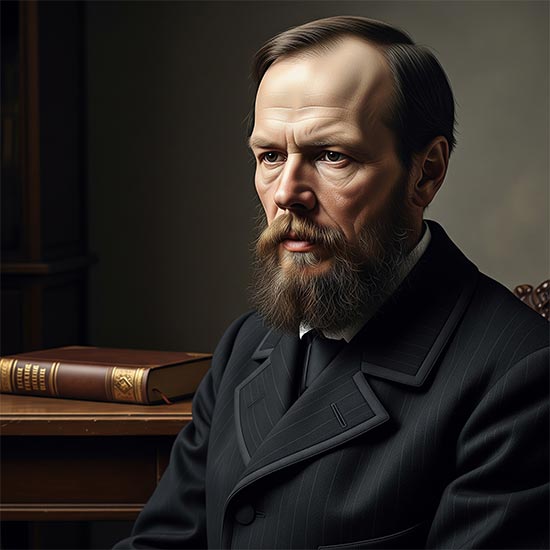
Fyodor Dostoevsky: The Unsettling Genius of A Journey into the Human Psyche
Have you ever read a book that felt less like a story and more like a fever dream, a deep dive into the darkest, most unsettling corners of the human mind? If so, chances are you’ve encountered the works of Fyodor Dostoevsky. While other novelists might meticulously craft tales of love, adventure, or societal commentary, Dostoevsky was a relentless explorer of the soul. His characters aren’t just people; they’re walking, talking battlegrounds for faith and atheism, good and evil, and the very nature of free will. His prose can be chaotic, his narratives unsparing, and his themes often brutal, yet he remains one of the most influential and celebrated writers in history. But what makes his work so captivating, and why, more than a century after his death, does he still speak to us with such force? Let’s take a journey into the life and mind of this literary titan to find out.
A Life Forged in Fire: Dostoevsky’s Turbulent Beginnings
To understand Dostoevsky’s art, you first have to understand his life. It wasn’t an easy one. He was born in Moscow in 1821, the son of a difficult and abusive father who was a doctor at a hospital for the poor. This early exposure to suffering and social injustice would deeply color his later work. His father’s death, which Dostoevsky believed was at the hands of his own serfs, was a traumatic event that haunted him for the rest of his life. These early experiences weren’t just background noise; they were the raw material from which he forged his characters and themes.
The Early Struggles and the Mock Execution
After a brief stint as a military engineer, Dostoevsky turned to writing. His first novel, Poor Folk, was a critical success, but the fame was short-lived. He soon fell in with a group of radical intellectuals known as the Petrashevsky Circle. Their crime? Discussing forbidden topics like socialism and political reform. In 1849, the entire group was arrested. What followed was a moment that would forever change his life and work. After months of imprisonment, Dostoevsky and his fellow conspirators were led out to be executed. They were tied to poles, a firing squad was assembled, and the last rites were read. Then, at the very last second, a messenger arrived with a pardon from Tsar Nicholas I. The execution was a sham, a cruel psychological torture designed to break their spirits. Dostoevsky was reprieved, but the experience of staring death in the face left an indelible mark. This moment of extreme duress, the confrontation with mortality, is a recurring theme in his novels.
Siberia’s Shadow: Transformation and Spiritual Awakening
The reprieve wasn’t a full pardon; Dostoevsky was sentenced to four years of hard labor in a Siberian prison camp, followed by six years of compulsory military service. This was a brutal, soul-crushing experience. But it was also in Siberia, surrounded by thieves, murderers, and outcasts, that Dostoevsky underwent a profound spiritual transformation. He was given a copy of the New Testament, the only book allowed, and he devoured its contents. This period solidified his deep faith in Russian Orthodox Christianity and his belief in the inherent dignity of even the most fallen human beings. He saw the “light” in the eyes of his fellow prisoners and began to explore the idea of redemption through suffering. This spiritual journey is at the very heart of his later novels.
The Literary Titans of Russia: Dostoevsky vs. Tolstoy
When we talk about Russian literature, two names inevitably come to mind: Dostoevsky and Leo Tolstoy. They were contemporaries, and though they never met, their works are often seen as two sides of the same coin. Tolstoy, the aristocratic count, wrote sweeping epics like War and Peace and Anna Karenina. His narratives are vast, his characters are deeply embedded in their social world, and his prose is famously clear and elegant. He was a master of the external world, meticulously describing the lives of the Russian gentry.
A Tale of Two Worldviews
Dostoevsky, on the other hand, was the city-dweller, the voice of the downtrodden and the outcast. His novels are claustrophobic, intense, and often set in the cramped, grimy apartments of St. Petersburg. Where Tolstoy describes the external world, Dostoevsky drills down into the internal. He’s not concerned with the “what” of a character’s actions so much as the “why” the twisted, contradictory motives that lie beneath the surface. He was, in essence, a psychologist before the field even existed.
Realism, Psychology, and the Grand Metaphysical Questions
While both are considered masters of realism, they approached it from different angles. Tolstoy’s realism is like a detailed photograph, capturing every nuance of a scene. Dostoevsky’s is more like a psychological portrait, a distorted reflection in a funhouse mirror that reveals the truth about a character’s soul. He was obsessed with the grand metaphysical questions: the existence of God, the nature of good and evil, the meaning of suffering. Tolstoy’s characters struggle with love and loss within a social framework; Dostoevsky’s characters grapple with the very fabric of existence itself.
Delving into the Masterpieces: Exploring Dostoevsky’s Core Themes
Dostoevsky’s novels are not light reading; they are philosophical and psychological rollercoasters. Each one is a dense and complex exploration of human nature, but a few stand out as cornerstones of his legacy.
Crime and Punishment: The Psychology of Guilt
Perhaps his most famous work, Crime and Punishment, is a brilliant psychological thriller that asks a terrifying question: can a person be so exceptional that they are morally exempt from the laws of society? . The protagonist, Rodion Raskolnikov, is a poverty-stricken student who murders a pawnbroker to prove a philosophical point. He believes he is a “superman” who can transcend conventional morality for the greater good. The rest of the novel is a torturous journey through his guilt, paranoia, and psychological unraveling. It’s a gripping exploration of the human conscience and a powerful argument that no matter how hard we try to escape our moral compass, it will always find a way to drag us back to reality.
The Idiot: The Christ-like Figure in a Corrupt World
In The Idiot, Dostoevsky sets out to create a truly good and beautiful man, a kind of modern-day Christ figure, and then thrusts him into a cynical, decadent society. Prince Myshkin, the protagonist, is naive, compassionate, and suffers from a form of epilepsy that Dostoevsky himself experienced. His goodness, rather than being a source of strength, makes him vulnerable and misunderstood. The novel explores the idea that true innocence and moral purity are impossible to maintain in a fallen world.
The Brothers Karamazov: Faith, Doubt, and Familial Strife
Considered by many to be his magnum opus, The Brothers Karamazov is a sprawling novel that tackles the big questions head-on. It’s a story of parricide, yes, but it’s also a profound theological and philosophical debate disguised as a crime novel. The three brothers the passionate Dmitri, the intellectual Ivan, and the devout Alyosha represent different facets of humanity’s struggle with faith and reason. Ivan’s “Grand Inquisitor” chapter is one of the most famous passages in all of literature.
The Grand Inquisitor: A Philosophical Showdown
In this brilliant philosophical parable, Ivan Karamazov tells his brother Alyosha a story about the return of Jesus to 16th-century Spain during the Inquisition. The Grand Inquisitor, an old, powerful cardinal, has Jesus arrested and tells him that the Church no longer needs him. Why? Because people don’t want freedom; they want happiness and security. They are too weak to bear the burden of free will, so the Church has taken it from them, providing them with “miracle, mystery, and authority” instead. It’s a chilling argument against freedom and a terrifying look at what happens when institutions believe they know what’s best for humanity.
The Enduring Legacy of Dostoevsky
Why, then, is Dostoevsky still so relevant? His novels are not easy reads. They are dense, emotionally exhausting, and often uncomfortable. Yet, they have a powerful pull that few other books can match.
Influence on Philosophy and Psychology
Dostoevsky’s influence on modern thought is undeniable. He is often credited as a precursor to existentialism, a philosophical movement that emphasizes individual freedom, choice, and responsibility. Thinkers like Jean-Paul Sartre and Albert Camus saw in Dostoevsky’s characters the fundamental struggle of a person trying to find meaning in a meaningless universe. His deep psychological insight also laid the groundwork for modern psychology. Sigmund Freud, for example, considered The Brothers Karamazov one of the greatest novels ever written, praising its exploration of patricidal guilt and the Oedipus complex.
Why We Still Read Dostoevsky Today
In a world that often feels chaotic and morally ambiguous, Dostoevsky’s novels offer a kind of strange comfort. He doesn’t shy away from the ugly parts of human nature the cruelty, the lust, the greed, the hypocrisy. But he also shows us the potential for redemption, the flicker of a soul’s light even in the deepest darkness. He reminds us that there is a profound difference between right and wrong, even when it’s hard to see, and that true freedom lies not in breaking all the rules but in choosing the path of goodness.
Timeless Relevance in a Modern World
Dostoevsky’s themes are timeless because they are so fundamentally human. The struggle with faith, the search for meaning, the burden of guilt, and the desire for freedom these are not just historical curiosities; they are the very things we grapple with every day. His characters, though from a different era, feel remarkably familiar. We see Raskolnikov’s pride, Prince Myshkin’s naive goodness, and Ivan Karamazov’s intellectual torment in the people around us, and perhaps even in ourselves.
Conclusion: The Unforgettable Echo of Dostoevsky’s Words
Fyodor Dostoevsky wasn’t a writer who offered easy answers. He was a master of the question. He plunged into the abyss of the human psyche and came back with a stark, often terrifying, but ultimately hopeful message: that even in our darkest moments, there is a path to redemption, and even in our deepest despair, there is a chance for faith. Reading his work is not just an intellectual exercise; it’s a spiritual one. It forces you to confront your own beliefs, your own morality, and your own place in the world. And in a time of so much uncertainty, that kind of challenge is more valuable than ever. His legacy is not just in the books he left behind, but in the unforgettable echo of his words that continues to resonate in the hearts and minds of readers all over the world.
Frequently Asked Questions (FAQs)
1. What is the main theme of Dostoevsky’s novels?
Dostoevsky’s novels are primarily concerned with the psychological and spiritual struggles of his characters. He explores themes like faith versus atheism, the nature of good and evil, the concept of free will, and the possibility of redemption through suffering. His work is a deep dive into the inner workings of the human psyche.
2. Which Dostoevsky book should I read first?
Many people start with Crime and Punishment, as it’s his most accessible and well-known work. It’s a gripping psychological thriller with a clear narrative arc. Other great starting points include Notes from Underground, a shorter but powerful work that introduces many of his key themes, or The Idiot, if you’re looking for a more character-driven story.
3. What is the significance of the “Grand Inquisitor” chapter?
The “Grand Inquisitor” chapter from The Brothers Karamazov is a powerful philosophical parable that explores the conflict between freedom and happiness. It argues that humanity, in its weakness, would rather give up its freedom of choice for the security and comfort offered by an authority figure, a theme that has been incredibly influential in philosophy and political thought.
4. How did Dostoevsky’s life experiences influence his writing?
Dostoevsky’s tumultuous life, including his mock execution and four years of hard labor in Siberia, profoundly shaped his writing. These events gave him a unique perspective on suffering, redemption, and the nature of humanity, leading to his deep exploration of Christian themes and his empathetic portrayal of society’s outcasts and criminals.
5. How is Dostoevsky different from Leo Tolstoy?
While both are literary giants, Tolstoy and Dostoevsky have distinct styles and themes. Tolstoy is known for his clear, elegant prose and for writing sweeping epics that focus on the external world and social commentary (War and Peace). Dostoevsky’s work is more intense and psychological, often set in claustrophobic urban environments and delving into the internal struggles of his characters. He was a master of the “why” of human action, whereas Tolstoy focused on the “what.”