
Aleksandr Solzhenitsyn, The Conscience of a Nation: Exploring the Life and Legacy of a Soviet Dissident
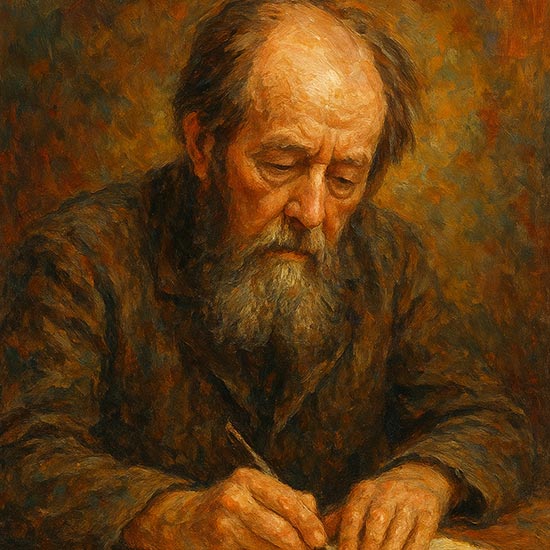
Have you ever wondered what it takes to stand up to an entire state and, with nothing but the power of words, bring it to its knees? That’s the story of Aleksandr Solzhenitsyn. He was a man who went from being a decorated Red Army captain to a prisoner in one of the most brutal labor camp systems the world has ever known. But instead of being broken by his experiences, he was forged by them. He transformed the unspeakable horror of the Soviet Gulag into a powerful, unshakeable truth, a literary testament that exposed the rot at the heart of the Soviet Union. His mission was simple: to bear witness. To ensure that the millions who suffered and perished in the labor camps would not be forgotten. He was not just a writer; he was a moral force, a prophet who used his own pain to awaken the conscience of a nation and, ultimately, to change the course of history.
A Life Shaped by War, Prison, and an Unyielding Belief
To understand Solzhenitsyn’s writing, you have to first understand the life that created it. It was a life of profound injustice, one that tested the limits of his endurance and strengthened his moral resolve.
From Young Patriot to Prisoner of the State
Solzhenitsyn was born in 1918, just after the Russian Revolution. He grew up as a passionate and patriotic young man, a believer in the ideals of the revolution. He studied mathematics and physics, and when World War II broke out, he served as an artillery officer in the Red Army, fighting with distinction and earning two medals. He was a product of the Soviet system, and for a time, he believed in it. But his fate changed in 1945. While serving on the front lines, he wrote a letter to a friend in which he mildly criticized Stalin’s conduct of the war. That letter was intercepted by Soviet counterintelligence. He was immediately arrested.
A Secret Letter and a Life in the Gulag
The “crime” for which he was arrested seems almost laughably trivial today, but in the Soviet Union, it was a death sentence. He was charged with “anti-Soviet agitation” and sentenced to eight years in a labor camp the Gulag. This was not a quick punishment; it was a slow, deliberate form of torture. He was forced to work in quarries and to build houses, all while enduring starvation, sickness, and the brutal cold of the Russian winters. These years in the Gulag were the crucible in which he was forged. He saw the system from the inside out, and he met a vast number of people who, like him, had been thrown away by the state for the slightest transgression. He was no longer a patriot; he was a witness.
A Time of Writing and Reflection
After serving his sentence, Solzhenitsyn was sent to internal exile in Kazakhstan. But even this wasn’t the end of his suffering. In 1953, he was diagnosed with cancer, a disease that seemed to be a final, cruel twist of fate. He was sent to a hospital in Tashkent, an experience he would later fictionalize in his novel, Cancer Ward.
The Diagnosis and the Beginning of a Literary Mission
The cancer diagnosis was a wake-up call. Facing death, he realized he had a moral duty to tell the world what he had seen. He had a story to tell, and if he didn’t tell it, who would? He made a personal vow to dedicate his life to exposing the truth about the Gulag. He began to write in secret, keeping his manuscripts hidden, often in the pockets of friends, knowing that if the KGB found them, his life would be over.
The Solzhenitsyn Style: Brutal Honesty as a Literary Weapon
Solzhenitsyn’s writing is not beautiful in the traditional sense. It’s raw, powerful, and uncompromising. He didn’t seek to entertain; he sought to inform and to bear witness.
The Power of Eyewitness Testimony
His literary style is based on the power of eyewitness testimony. He wrote from his own lived experience, and he incorporated the experiences of hundreds of other prisoners he met in the Gulag. He used their stories, their anecdotes, and their suffering as the building blocks of his work. His writing feels less like fiction and more like a detailed report from the front lines of human suffering. This authenticity is what gives his work its incredible moral authority.
Documenting the Undocumented
The most powerful aspect of his writing is his ability to document the undocumented. He brought to life the details of the Gulag the meager rations, the brutal work, the freezing conditions, the casual cruelty of the guards. He named names and described places, creating a concrete, irrefutable record of a system that the Soviet state claimed didn’t exist. He gave a face and a name to the faceless millions who had disappeared.
The Moral Compass of his Prose
There is a clear moral compass guiding all of Solzhenitsyn’s work. He saw the world in terms of good and evil, truth and lies. His writing is a moral call to action. He believed that the artist had a responsibility to be the conscience of society. His prose is filled with a sense of righteous anger, a moral outrage at the injustice he had witnessed.
A Voice of Righteous Anger and Prophetic Warning
His writing is not just a historical account; it’s a prophetic warning. He saw the Soviet system as a spiritual and moral wasteland, a place where lies were truth and vice versa. He warned that the West, in its naive attempts to appease the Soviet Union, was making a grave mistake. He saw the rot at the heart of communism, and he spent his life trying to warn the world about the dangers of a godless, totalitarian state.
Unveiling the Gulag: A Deep Dive into His Masterpieces
Solzhenitsyn’s literary output is a testament to his immense will and his dedication to his mission. His three most famous works are powerful and different expressions of the same central idea: the reality of the Gulag.
One Day in the Life of Ivan Denisovich: A Glimpse into the Abyss
His first published work, One Day in the Life of Ivan Denisovich, was a sensation. Published in 1962, during a brief period of Khrushchev’s “thaw,” it was the first time an official Soviet publication had ever acknowledged the existence of the labor camps. The novel is a stark, honest, and powerful account of a single day in the life of a Gulag prisoner.
The Simplicity of a Single Day’s Struggle
The power of the novel lies in its simplicity. It’s not a grand, sprawling epic. It’s a microscopic examination of a single day a day of hunger, cold, and dehumanizing labor. By focusing on the small, daily struggles of Ivan Denisovich, Solzhenitsyn makes the immense suffering of the Gulag system understandable and deeply human. He shows us how a man can maintain his dignity and his humanity in the face of unspeakable evil. .
The Gulag Archipelago: An Epic of Suffering
The Gulag Archipelago, published in 1973, is a different kind of book entirely. It’s a massive, three-volume work that is a blend of history, memoir, and sociological study. Solzhenitsyn called it an “experiment in literary investigation.” It’s not a novel; it’s a systematic, detailed, and utterly devastating exposé of the Soviet prison system.
The System of Terror Laid Bare
In The Gulag Archipelago, Solzhenitsyn lays bare the entire system of Soviet terror. He documents everything: the arrests, the interrogations, the forced labor, the cruelty of the guards, the mass deaths. He maps out the “archipelago” of labor camps that stretched across the Soviet Union, and he shows how the entire system was built on a foundation of lies, fear, and human suffering. It was a book that the Soviet government tried desperately to suppress, but once it was published in the West, it became impossible to ignore. It changed the world’s perception of the Soviet Union forever.
Cancer Ward: The Hospital as a Microcosm of Society
His novel Cancer Ward is a more allegorical work. It’s set in a Soviet hospital’s cancer ward, and the patients are a microcosm of Soviet society. They are all dying, both literally and figuratively, from a society that is a kind of spiritual cancer. The novel is a profound meditation on life and death, on freedom and tyranny. It shows that even in the face of death, there is a chance for redemption and a chance to find the truth.
The Controversial Figure: Exile, Fame, and Later Life
The publication of The Gulag Archipelago made Solzhenitsyn a global literary star, but it also made him a pariah in his own country.
The Nobel Prize and Forced Exile
In 1970, he was awarded the Nobel Prize in Literature “for the ethical force with which he has pursued the indispensable traditions of Russian literature.” He was unable to travel to Sweden to accept the award for fear that the Soviet government would not allow him to return. But the Nobel Prize, along with the international success of his works, gave him a level of protection. In 1974, after a final, desperate attempt to silence him, the Soviet government arrested him, stripped him of his citizenship, and forcibly exiled him.
The Prophet in the Wilderness
He spent the next twenty years living in the West, first in Switzerland and then in the United States. He was a hero to many, but he was also a controversial figure. He was deeply critical of the materialism and spiritual emptiness of the West, and his uncompromising moralism often made him seem out of place. He was, in a sense, a prophet in the wilderness, a man who saw the truth but struggled to make others believe it.
The Return and The Final Years
After the collapse of the Soviet Union, Solzhenitsyn returned to Russia in 1994. He was welcomed as a national hero. He spent his final years in Russia, a respected but somewhat marginalized figure, a man who had outlived his own revolution. He died in 2008, a living legend, a man who had seen his life’s work come to fruition.
Solzhenitsyn’s Enduring Legacy
Solzhenitsyn’s legacy is immense. He is a literary giant, but he is also something more: a moral authority who changed the way the world saw one of the greatest political experiments in history.
A Moral Authority Who Changed the World
His work was a dagger plunged into the heart of the Soviet system. By exposing the truth of the Gulag, he helped to shatter the lies and the propaganda that had held the Soviet state together for so long. He was a key figure in the intellectual and moral collapse of the Soviet Union. His unwavering commitment to truth in the face of terror made him a moral beacon for millions around the world.
The Power of Truth in an Age of Lies
Solzhenitsyn’s greatest legacy is his belief in the power of truth. In a world where totalitarian regimes seek to control reality by controlling information, he showed that the truth, no matter how painful, is the most powerful weapon of all. His life and his work are a testament to the idea that a single person, armed with nothing but the truth, can stand up to an empire and win.
Conclusion: The Unconquerable Spirit of Aleksandr Solzhenitsyn
Aleksandr Solzhenitsyn was a man who stared into the abyss of human cruelty and did not blink. He was a writer who turned his suffering into a weapon and his art into an act of profound historical witness. He was not a perfect man, and his later life was filled with its own controversies, but his core mission remained the same: to tell the truth, no matter the cost. His work is a permanent record of one of the greatest tragedies of the 20th century, a raw, uncompromising monument to the victims of the Gulag. He reminds us that true courage is not found on the battlefield but in the quiet, unyielding voice of a man who refuses to be silenced.
Frequently Asked Questions (FAQs)
1. What was the Gulag?
The Gulag was the system of Soviet labor camps that existed from the 1920s to the 1950s. It was a vast network of prisons and camps where millions of people were sent to perform forced labor, often for political “crimes.” Solzhenitsyn was a prisoner in the Gulag for eight years.
2. Why was Solzhenitsyn exiled from the Soviet Union?
Solzhenitsyn was exiled from the Soviet Union in 1974 after the international publication of his groundbreaking work, The Gulag Archipelago. The Soviet government was enraged by his exposé of the prison system and viewed him as a traitor. They stripped him of his citizenship and forcibly removed him from the country.
3. What is the difference between “One Day in the Life of Ivan Denisovich” and “The Gulag Archipelago”?
One Day in the Life of Ivan Denisovich is a work of fiction that tells a single day’s story of one prisoner in the Gulag. The Gulag Archipelago is a three-volume work of non-fiction, a detailed literary investigation that exposes the entire system of Soviet terror. The first is a focused, human story; the second is a sweeping, historical document.
4. How did Solzhenitsyn’s time in the Gulag influence his writing?
His time in the Gulag was the central, defining experience of his life and the direct source of his most famous works. It gave him an unshakeable moral purpose and an intimate, firsthand knowledge of the system he would later expose. His writing became a way for him to bear witness to the suffering he had seen.
5. What happened to Solzhenitsyn after the collapse of the Soviet Union?
After the collapse of the Soviet Union, Solzhenitsyn returned to Russia in 1994. He was welcomed as a national hero and lived there until his death in 2008. He was respected by many but was also a somewhat controversial figure who was critical of the new, more Westernized Russia.