
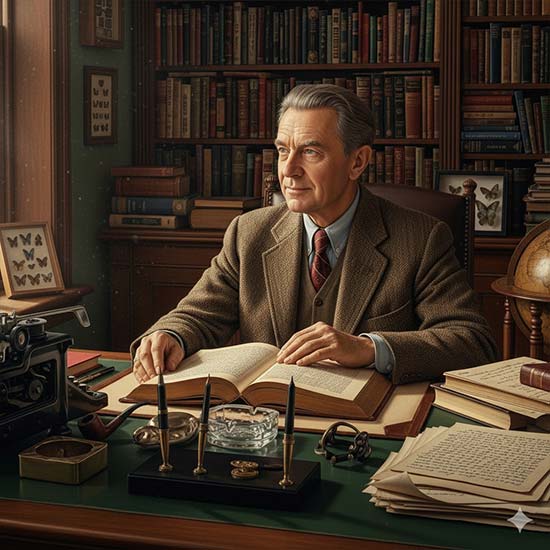
Vladimir Nabokov, the Architect of Worlds: Unraveling the Genius of Vladimir Nabokov.
Vladimir Nabokov was a literary polymath a novelist, a poet, a memoirist, a translator, a literary critic, and even a distinguished entomologist. But more than anything, he was an architect of worlds, a craftsman who created dazzling and complex universes within the pages of his books. Nabokov wasn’t interested in the easy answers or the moralistic tales of his contemporaries. He was a champion of aesthetic pleasure and the power of language, a writer who believed that the true magic of fiction lay in its style, its precision, and its ability to create a beautiful, self-contained universe. His life was a remarkable journey of exile and reinvention, a story that is as fascinating as any of his books.
A Life of Exile and Transformation: The Early Years
To understand Nabokov’s work, you must first understand the man. Born in St. Petersburg in 1899, he came from an immensely privileged, aristocratic family. His father, Vladimir Dmitrievich Nabokov, was a prominent liberal politician and a legal scholar. Their home was a vibrant intellectual hub, filled with books and a love of learning.
The Russian Aristocrat’s Childhood
Nabokov’s childhood was, by his own account, an idyllic one. It was a world of country estates, summer holidays, and a family that encouraged his every curiosity. He was raised with a rare gift: he was trilingual from a young age, speaking Russian, English, and French with equal fluency. This command of multiple languages gave him a unique perspective on literature, a perspective that would later allow him to transition from writing in Russian to becoming one of the great stylists of the English language.
A Trilingual Upbringing and Passion for Butterflies
This linguistic prowess wasn’t his only passion. From a very young age, Nabokov was obsessed with lepidopterology the study of butterflies. He would spend hours meticulously observing, catching, and cataloging specimens. This fascination with butterflies, with their intricate patterns and delicate transformations, is not just a quirky detail about his life. It’s a key to understanding his art. Nabokov saw the world as a complex tapestry of patterns, and he brought the same precise, observant eye of a scientist to his writing, carefully placing every character, every symbol, and every detail with a purpose.
The Russian Revolution and the Great Escape
This privileged world came to a shattering end in 1917 with the Russian Revolution. The Nabokov family was forced to flee their homeland, a traumatic event that marked the beginning of a life in exile. They left behind their wealth, their home, and their country. This sudden loss and the constant sense of displacement and nostalgia for a lost world would become a central theme in his Russian novels and a powerful undercurrent in all of his work. It’s a feeling many of his characters, exiles and wanderers themselves, share.
The Literary Butterfly: Nabokov’s Evolution as a Writer
Nabokov began his literary career in Berlin, where he wrote under the pseudonym “V. Sirin” to distinguish himself from his father. He produced several brilliant novels in Russian during this period, but the linguistic shift that would define his legacy was still to come.
The Berlin Years and Russian-Language Novels
In the bustling, bohemian atmosphere of 1920s and 1930s Berlin, Nabokov found his voice. He wrote novels like Laughter in the Dark, a chilling story of a man’s descent into a kind of personal hell, and The Gift, his most autobiographical and deeply layered Russian novel. These early works are remarkable for their stylistic brilliance and their intricate, often playful, narrative structures. They show a writer already at the height of his powers, even before he found his global audience.
Mashenka (Mary) and the Theme of Nostalgia
His first Russian novel, Mashenka (translated as Mary), is a beautiful, melancholic exploration of nostalgia. It tells the story of a Russian émigré in Berlin who discovers that a former love from his youth is also living in the same boarding house. The novel is less about a physical reunion and more about the vivid, painful, and ultimately untrustworthy nature of memory. It is a theme Nabokov would return to again and again, especially the idea that our memories are a kind of fiction we create for ourselves.
The Shift to English: An Act of Creative Rebellion
With the rise of Nazism in Germany, Nabokov and his family were forced to flee again, first to France and then, in 1940, to the United States. It was here, in America, that he made a bold, defiant, and ultimately career-defining decision: to switch his primary writing language from Russian to English. This was not a simple transition. It was an act of creative rebellion, a challenge he undertook with the same meticulousness he applied to his butterfly research.
The Challenge of a New Language
Writing in English was a daunting task. Nabokov felt it was like “a new country of which I knew all the towns and suburbs but none of the native expressions.” Yet, he did more than just master the language; he made it his own. He created a style that was simultaneously ornate, precise, and playful. He reveled in puns, alliteration, and complex wordplay, showing a linguistic virtuosity that made his writing immediately recognizable. He proved that he was not a product of his native tongue, but a literary genius whose talent transcended any single language.
The Labyrinthine Worlds of Nabokov’s Masterpieces
Nabokov’s English novels are a stunning display of his intellectual and artistic prowess. They are not to be read passively; they demand active participation from the reader.
Lolita: The Scandalous Sensation and a Linguistic Masterclass
No discussion of Nabokov is complete without Lolita . Published in 1955, it was a sensation for its scandalous subject matter, but its true genius lies in its prose. The novel is narrated by Humbert Humbert, a pedophile who is utterly repulsive in his actions yet utterly seductive in his language. Nabokov forces the reader into an uncomfortable position, making us complicit in Humbert’s perspective. It’s a breathtaking and disturbing exploration of an unreliable narrator, and a testament to the power of language to make the unspeakable sound beautiful. The book, as Nabokov himself said, is less about a perverted man and more about “the love of words.”
The Alluring Unreliability of a Narrator
Humbert Humbert is a master manipulator. He twists language, uses complex literary allusions, and presents his grotesque actions in a way that attempts to justify them. As a reader, we are constantly aware that we are being manipulated, but the sheer beauty of the prose makes it difficult to turn away. Nabokov uses this narrative trick to demonstrate that even the most heinous acts can be obscured by beautiful language.
Pale Fire: The Ultimate Literary Puzzle
If Lolita is a puzzle box, then Pale Fire (1962) is a hall of mirrors. The novel is presented as a 999-line poem by a fictional poet, John Shade, and an accompanying foreword and commentary by his eccentric and possibly insane neighbor, Charles Kinbote. Kinbote’s commentary, which gradually takes over the text, turns the book into a bewildering, hilarious, and ultimately tragic narrative about art, madness, and the unreliability of memory. It’s a novel that challenges the very nature of authorship and interpretation.
The Art of the Narrative Trick
Pale Fire is a masterpiece of metafiction, a story that is self-aware of its own nature as a work of art. The reader is tasked with sifting through Kinbote’s mad ravings to piece together the “true” story of John Shade’s death. Nabokov, the great entomologist, is essentially asking us to be literary detectives, to carefully examine the patterns and clues he has left for us. It’s a brilliant game, and one that has captivated scholars and readers for decades.
Pnin: A Sympathetic Portrait of a Misfit
Amidst the complex structures of his more famous works, Pnin (1957) stands out for its warmth and a genuine, if ironic, sympathy. It’s a series of interconnected vignettes about Timofey Pnin, a kind-hearted, bumbling Russian émigré professor in an American university. While the book is filled with Nabokov’s signature wordplay and wit, it is also a touching and poignant portrait of a man who, despite his constant misadventures, retains a fundamental innocence and dignity.
Nabokov’s Unmistakable Style and Enduring Legacy
Nabokov’s influence on modern literature is profound and undeniable. He didn’t just write stories; he created an entire literary aesthetic.
The Dangers of “General Ideas”: A Writer’s Philosophy
Nabokov famously despised “general ideas” in art. He believed that literature should not be a vehicle for social or political messages. His focus was on the individual detail, the specific, the particular. He argued that the true power of a work of art lies in its ability to create a self-contained world of beauty and intricacy. He saw the writer’s job as a kind of magic trick, a sleight of hand that creates an illusion of reality.
Influence on Literature and Pop Culture
Nabokov’s work has had a lasting impact on writers who followed him, from John Updike to Thomas Pynchon. His use of unreliable narrators, his intricate plots, and his celebration of language as an end in itself have become hallmarks of modern literature. Beyond the literary world, his novels, particularly Lolita, have been adapted for the screen multiple times, and his aesthetic has inspired countless artists, musicians, and filmmakers.
From Literary Criticism to Cinematic Adaptations
Nabokov was also an influential literary critic, and his lectures on European literature are still studied today. He was a champion of the authors he admired, like Joyce and Proust, and his sharp, often scathing, critiques of those he didn’t like are legendary. His insistence on reading with an eye for detail and his celebration of the aesthetic over the moral has reshaped how many people approach literature.
Conclusion: The Unforgettable Artifice of a Master
Vladimir Nabokov was a writer of staggering intellect, a man who saw the world as a grand, intricate design. He was an exile who found a home in the English language, a scientist who brought a meticulous eye to the art of storytelling, and a provocateur who challenged his readers to look beyond the surface. His novels are not just books; they are elaborate, beautiful traps designed to catch the reader’s imagination and hold it captive. He taught us that a story can be a puzzle, a linguistic game, and a work of profound beauty all at once. For Nabokov, the greatest act of all was not just to tell a story, but to construct a world, one perfectly chosen word at a time.
Frequently Asked Questions (FAQs)
1. What is Vladimir Nabokov’s most famous book?
Vladimir Nabokov is most famous for his 1955 novel, Lolita. The book achieved widespread notoriety for its controversial subject matter but is also celebrated for its brilliant prose, complex structure, and its masterful use of an unreliable narrator.
2. Why did Nabokov switch from writing in Russian to English?
Nabokov made the difficult transition from writing in his native Russian to writing in English after he and his family emigrated to the United States in 1940. He believed that to continue writing in Russian would have made his work inaccessible to a wider audience, and he embraced the challenge of mastering a new language as an artistic endeavor.
3. What is the significance of butterflies in Nabokov’s work?
Nabokov was a professional entomologist and a world-renowned expert on butterflies. His passion for this scientific field is reflected in his writing through his meticulous attention to detail, his fascination with patterns, and his love of symmetry. The butterfly often appears as a symbol of transformation and beauty in his novels.
4. What is the main theme of Pale Fire?
Pale Fire is a complex novel that explores several key themes, including the nature of authorship, the unreliability of memory, and the relationship between art and madness. The book is structured as a puzzle, with a poem and a commentary that ultimately creates a new narrative about a man’s descent into a kind of self-created delusion.
5. Was Nabokov a teacher?
Yes, Vladimir Nabokov taught at several American universities, including Wellesley College and Cornell University, where he was a professor of Russian and European literature. His lectures were famous for their detailed analyses of works by authors like Proust, Joyce, and Kafka, and he emphasized a close reading of the text over a focus on broad, “general ideas.”