

The Kreutzer Sonata Tolstoy Summary
A Comprehensive and Complete Summary of Tolstoy’s The Kreutzer Sonata
Have you ever read a book that made you feel deeply uncomfortable, yet you couldn’t put it down? That’s exactly the experience of reading Leo Tolstoy’s powerful and deeply unsettling novella, “The Kreutzer Sonata.” First published in 1889, this is not a feel-good story. It’s a chilling, first-person confession of a man who murdered his wife, and in doing so, reveals a dark, cynical, and utterly brutal philosophy on love, marriage, and human nature. This is Tolstoy at his most radical and controversial, a man who, late in life, had come to see the world in a way that challenged every societal convention. If you’re ready for a gut-wrenching, thought-provoking journey, then let’s dive into the heart of this masterpiece.
The Controversial Masterpiece: Why “The Kreutzer Sonata” Still Shocks Us
When “The Kreutzer Sonata” was first published, it caused a scandal. Readers were shocked by its extreme views on sex, its bleak portrayal of marriage, and its unflinching look at the inner workings of a jealous mind. It was censored in Russia and banned in some parts of the United States. Even today, its themes feel raw and relevant. It’s a book that forces us to confront our own ideals about love and relationships, and to question whether our societal norms are built on a foundation of truth or just convenient lies.
The Context: Tolstoy’s Spiritual Crisis and Radical Views
By the time he wrote this novella, Tolstoy had already gone through his profound spiritual crisis, the one he detailed in “A Confession.” He had rejected his fame, wealth, and the hypocrisy of the Russian Orthodox Church. He was on a new path, embracing a strict form of asceticism and Christian anarchism. His views on sexuality, in particular, had become extreme; he came to believe that physical desire was the source of all human suffering and that the only true path to salvation was through complete chastity, even within marriage. This book is a fictionalized, but no less passionate, exploration of those radical ideas.
A Shocking Story, a Profound Truth
The story is simple, but its themes are vast. It’s a tragedy that unfolds in a single, intense conversation. Tolstoy uses the protagonist’s descent into madness to expose what he sees as the fundamental moral and spiritual sickness of society. He argues that our pursuit of romantic love is a thin veil over our true, base desires, and that this deception inevitably leads to resentment, conflict, and violence.
The Protagonist: The Confession of Pozdnyshev
The entire novella is a monologue, a powerful and disturbing confession from the main character, Pozdnyshev.
The Setting: A Train Journey into the Human Psyche
The story begins on a train. A group of travelers is engaged in a debate about love, marriage, and passion. One woman argues that true love, in its purest form, can conquer all. The men, predictably, are more cynical. It’s in the midst of this conversation that a pale, gaunt man with a burning gaze, Pozdnyshev, interjects. He is a stranger to them, but he has been listening, and he has a story to tell—a story that will shatter all their comfortable assumptions. He takes over the narrative, and we, the readers, become the audience to his horrifying tale.
The Stranger on the Train: A Man with a Story
Pozdnyshev is a man haunted by his past. His eyes are filled with a deep, consuming anguish. He knows that his story is shocking, but he feels compelled to tell it, to lay bare the truth as he sees it, no matter how ugly. He is not seeking pity; he is trying to teach a lesson, to warn the world about the dangers of its false ideals.
The Framing Device: A Window into a Troubled Soul
The genius of Tolstoy’s narrative is this framing device. By making the story a first-person confession, he pulls us into Pozdnyshev’s mind. We don’t just hear about his jealousy and rage; we feel it, we see the world through his twisted, paranoid lens. This forces us to grapple with his logic, however flawed, and to confront the dark side of human nature.
Part I: A Life of Lust and a Marriage Built on Sand
Pozdnyshev begins his story by recounting his youth, a time he now sees as a period of profound spiritual corruption.
The False Promises of Youth
He describes his early life as a series of dissolute and empty experiences. He was a wealthy young man who gave himself over to lust, believing that it was a natural part of a gentleman’s life. He viewed women as objects of pleasure, and he saw his relationships with them as nothing more than a series of conquests. He now looks back on this time with immense shame and regret, believing that it was this early behavior that set him on his tragic path.
The Emptiness of Worldly Passions
He argues that society’s view of love and sexuality is deeply flawed. He believes that the education young men receive, which teaches them to seek pleasure and to view women as commodities, is a form of moral poison. This early corruption, he claims, makes a man incapable of true, pure love.
The Tragic Love Affair and a Flawed Union
Pozdnyshev then recounts how he met his future wife. He was looking for a partner, but he was still operating from a place of lust and selfishness. He describes the courtship as a period of deception, where both he and his future wife were putting on a performance. They were both trying to appear to be something they were not, and the very foundation of their relationship was a lie.
The Illusory Nature of Romantic Love
He claims that what people call “love” is nothing more than a temporary state of infatuation, a biological trap designed to lead to procreation. He says that the so-called “happiest time” of his marriage was nothing more than the culmination of his lust. Once the initial passion faded, the resentment began to build. They were two strangers, tied together by a social contract and a handful of shared passions, but with no real, spiritual connection. He insists that most marriages are like this, a slow, agonizing descent into mutual hatred.
Part II: The Descent into Jealousy and The Kreutzer Sonata
After the initial passions faded, a deep-seated resentment took over the marriage. Pozdnyshev and his wife began to argue constantly, and the arrival of their children, instead of bringing them closer, only seemed to deepen the chasm between them. This unhappy stalemate continued until a fateful day when a new person entered their lives.
The Arrival of the Catalyst: The Musician
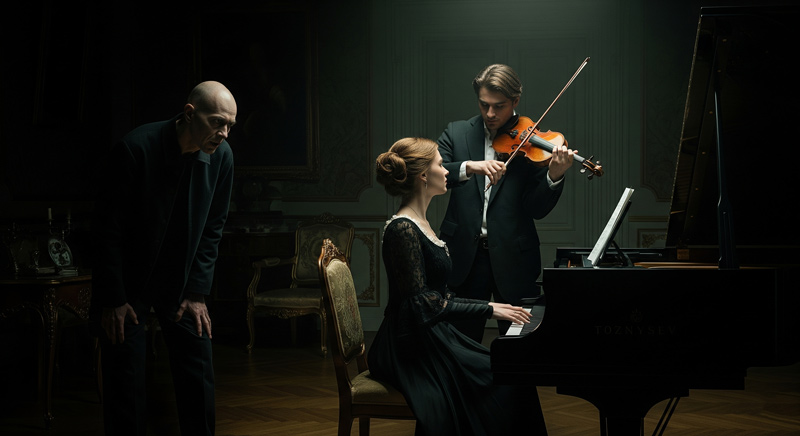
A violinist named Trukhachevsky arrives at their home to rehearse with Pozdnyshev’s wife, who is a pianist. Pozdnyshev is instantly suspicious of the man. He sees in the musician a shallow, urbane man who views his wife with a predatory gaze. But his wife, starved for attention and intellectual stimulation, is thrilled to have a partner to play music with. The stage is set for a tragic misunderstanding.
The Performance and the Rising Tension
One evening, Pozdnyshev’s wife and Trukhachevsky decide to play Beethoven’s “Kreutzer Sonata” for an audience. Pozdnyshev describes the music as a powerful, almost demonic force. He says that it is a piece of art that should never be played in a drawing-room, that it is meant to stir the deepest, most dangerous passions within a person. As he watches them play, he is consumed by a horrifying jealousy. He sees their musical collaboration not as an artistic performance, but as an act of sexual intimacy.
The Spiral of Obsession and Paranoia
After the performance, Pozdnyshev becomes completely unhinged. He is filled with a terrible, all-consuming jealousy that poisons his every thought. He cannot eat, he cannot sleep, and he cannot stop thinking about his wife and the violinist. He convinces himself that they are having an affair, even though he has no proof. He sees their every glance, every conversation, as a sign of their mutual betrayal. His mind, already fragile and prone to extremes, completely breaks.
A Mind Consumed by Suspicion
Tolstoy masterfully portrays the psychological spiral of Pozdnyshev’s jealousy. It’s a self-feeding monster that grows larger and more monstrous with every passing moment. He is no longer a rational man; he is a man possessed. He leaves for a brief business trip, but he is unable to focus on his work. He is so consumed by his paranoia that he rushes back home, intent on confronting them.
Part III: The Violent Act and Its Aftermath
The final part of the story is the horrifying climax of Pozdnyshev’s journey.
The Final, Fatal Confrontation
When he arrives home, he finds his wife and Trukhachevsky together in the drawing-room. His rage boils over. He attacks his wife, and in his blind fury, he stabs her to death with a knife. He says he did not know what he was doing, that his actions were not his own, but were the result of a passion that had been building inside him for years. The act of murder is not a sudden, random event; it is the inevitable conclusion of a life lived in spiritual darkness and a marriage built on lies.
The Aftermath: Justice and a Hollow Victory
After the murder, Pozdnyshev is arrested and put on trial. He is acquitted, as the court deems that he was acting in a fit of passionate rage. He is a free man, but he is a man with a shattered soul. He lives the rest of his life as a recluse, a solitary figure who travels on trains and preaches his bleak and terrifying philosophy to anyone who will listen. He has achieved a kind of hollow victory, but he has lost everything in the process.
Thematic Analysis: Key Ideas to Ponder
“The Kreutzer Sonata” is a novel that is less about a man’s crime and more about Tolstoy’s radical beliefs.
The Deception of Love and the Reality of Lust
At its core, the novella is a scathing critique of romantic love. Pozdnyshev, as Tolstoy’s mouthpiece, argues that what society calls “love” is nothing more than a refined form of lust. He believes that this deception is the root cause of all unhappiness in marriage, as it creates an impossible ideal that no relationship can ever live up to.
The Power of Music as a Dangerous Force
Tolstoy uses Beethoven’s music as a powerful symbol of the dangerous, sensual forces that can lead to tragedy. He suggests that art, when it appeals to our passions rather than our moral centers, can be a destructive force. He argues that music, like the “Kreutzer Sonata,” has the power to unleash the basest emotions in us, and that this can lead to disaster if we are not spiritually strong enough to control them.
Tolstoy’s Controversial Take on Women and Marriage
The book is also famous for its deeply misogynistic views. Pozdnyshev argues that women are taught to use their sexuality to trap men, and that marriage is nothing more than a form of legal prostitution. He sees women as either innocent victims or cunning manipulators, with no room for a middle ground. Tolstoy’s views on this topic are undoubtedly extreme, and they have been a source of controversy for over a century.
The Destructive Nature of Jealousy
Finally, the novella is an unforgettable psychological portrait of jealousy. Tolstoy shows us how jealousy is not just a simple emotion, but a destructive, self-feeding monster that can consume a person’s entire being. He argues that it is a direct result of a lack of spiritual connection in a relationship, and that it can only be overcome through a complete rejection of all physical passion.
Conclusion: The Unforgettable Power of a Human Tragedy
“The Kreutzer Sonata” is a difficult and deeply disturbing book. But it is also a work of immense power and profound insight. It forces us to confront uncomfortable truths about love, jealousy, and the human psyche. While its views on women and sexuality are now largely considered archaic and extreme, its searing critique of a society built on lies and hypocrisy still rings true. It is a testament to Tolstoy’s genius, and it is a powerful reminder that the greatest art often comes from a place of profound spiritual struggle and a willingness to question everything we hold to be true. It’s a book that will make you think, even if it makes you squirm, and that is its greatest legacy.