Haji Murad Tolstoy Summary
A Comprehensive and Complete Summary of Tolstoy’s Haji Murad
Have you ever wondered what happens when a single, honorable person is caught between two powerful, warring empires? That’s the tragic, captivating question at the heart of Leo Tolstoy’s final masterpiece, “Haji Murad.” This isn’t a long novel; it’s a short, powerful novella that packs an incredible punch. It tells the true story of a famous Chechen warrior who defects from his commander, Shamil, and seeks refuge with the very Russian forces he had been fighting for years. It’s a gripping tale of loyalty, betrayal, and the fight for survival that will make you question the nature of war and the true meaning of honor. So, let’s explore this forgotten gem and see why it’s a must-read for anyone interested in history and human nature.
Why You Should Read “Haji Murad”: A Story of Honor and Conflict
“Haji Murad” is a standout in Tolstoy’s body of work. Unlike his grand, philosophical epics, this novella is a lean, fast-paced narrative that feels surprisingly modern. Tolstoy wrote it late in his life, and it’s a culmination of his views on the hypocrisy of the state, the senselessness of war, and the profound beauty of a life lived in harmony with nature. It’s a book that’s both a historical account and a powerful human tragedy.
The Historical Context: The Caucasian War and Imperialism
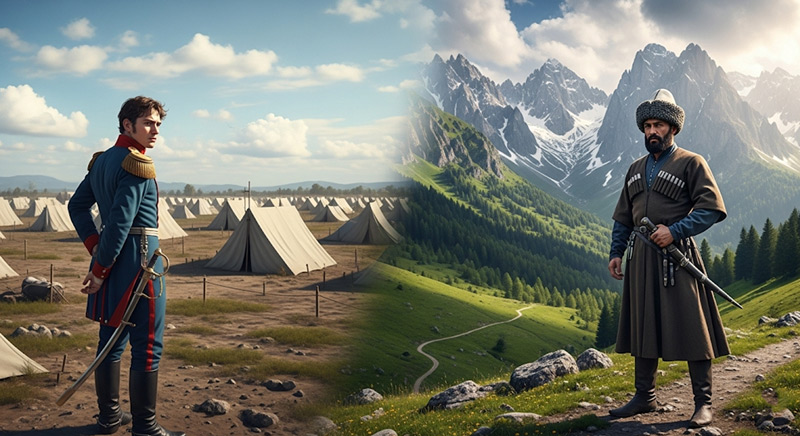
The story is set against the backdrop of the Caucasian War in the mid-19th century, a brutal and long-lasting conflict between the Russian Empire and the indigenous peoples of the Caucasus. Tolstoy, who served in the region as a young man, had a firsthand understanding of the conflict. He uses his experiences to paint a vivid picture of the two sides: the highly-organized, bureaucratic Russian army and the fiercely independent, honorable Chechen resistance.
The Enduring Themes of Loyalty and Betrayal
At its core, the novella is an exploration of loyalty and betrayal. Haji Murad’s defection is not a simple act of treason; it is a desperate choice made to save his family, who are being held hostage by his rival, Shamil. His story forces us to ask: What do you owe to your leader? To your people? To your family? And when do those loyalties become irreconcilable?
The Protagonist: The Life and Legacy of Haji Murad
The novel’s central character is based on a real person, Haji Murad, and Tolstoy’s portrayal is one of the most compelling in all of his work.
A Fateful Decision: The Defection of a Hero
Haji Murad is not a villain; he is a hero among his people, a respected and feared military leader known for his courage and cunning. He is a man of action, living by a strict code of honor. His decision to defect to the Russians is shocking to everyone, especially to the Russians themselves, who can’t quite grasp the reasons behind it.
The Burden of His Past and the Hope for a New Beginning
Haji Murad’s defection is an act of desperation. His family is in mortal danger, and he sees no other way to save them. He hopes that by aligning himself with the Russians, he can secure their release. However, he is constantly aware of the profound personal and social cost of his choice. He is an exile, a man without a home, a hero who has been forced to betray his own people.
The Complexities of His Character
Tolstoy portrays Haji Murad not as a black-and-white figure, but as a deeply complex man. He is a loyal friend, a devoted family man, and a ruthless warrior. He is a master strategist and a natural leader. He is also a man of immense pride and a deep sense of dignity, qualities that will ultimately lead to his tragic end.
The Two Worlds of Haji Murad: Russia and the Chechens
Haji Murad’s tragedy lies in the fact that he can never truly belong to either side. He is an outsider in the Russian camp, and he is a traitor to his own people. He is a bridge between two worlds, but that bridge is ultimately destroyed.
Part 1: The Arrival and the Russian Camp
The novella begins with Haji Murad’s dramatic arrival at the Russian camp.
A Glimpse into Russian High Society and Military Life
Tolstoy provides a scathing, satirical look at the Russian officers and officials. They are concerned with their careers, their social status, and their appearance. They are out of touch with the reality of the war and have a shallow, condescending view of the people they are fighting. They see Haji Murad as a curiosity, a valuable asset to be used, but not as a human being.
The Naive Generals and the True Nature of War
The Russian commanders are portrayed as naive and arrogant. They see war as a game of strategy and diplomacy, not as the brutal, bloody reality that it is. They are impressed by Haji Murad’s charisma and reputation but fail to grasp his true motivations and the desperate situation he is in. They are more interested in using him for their own gain than in helping him.
The Struggle to Understand a Stranger
The Russian officers and soldiers are completely unable to understand Haji Murad’s world. They see his honor and his pride as strange and alien concepts. His quiet dignity and his refusal to be a pawn in their game make them uncomfortable. They cannot understand a man who would risk everything for his family and his sense of self.
The Strategic Alliance and the Deceit of Diplomacy
The Russian command, led by General Vorontsov, decides to form a strategic alliance with Haji Murad. They promise to help him secure the release of his family, but their promises are hollow. They are using him as a bargaining chip, and they have no intention of fulfilling their end of the bargain. Tolstoy masterfully exposes the hypocrisy and deceit of the Russian bureaucracy.
Part 2: The Chechen Perspective and the Tragedy of Betrayal
The novel shifts perspective to show us Haji Murad’s world and his true motivations.
The Hero of the Mountains: His Life and Reputation
We are given a series of flashbacks that paint a detailed picture of Haji Murad’s life. We learn of his incredible bravery, his skill as a warrior, and his deep loyalty to his family. We see him not as a defector, but as a man who has been pushed to the very edge by a series of unfortunate events.
The Story of His Family and the Hostage Crisis
The heart of the story is the tragedy of his family. Shamil, his rival, has taken his family hostage and threatens to kill them. Haji Murad’s defection is not a choice; it is a desperate, final attempt to save the people he loves. Tolstoy shows us that his so-called “treason” is in fact the greatest act of loyalty he could make.
The Brutal Power of Shamil and the Inevitable Conflict
Tolstoy also provides a powerful portrait of Shamil, the Chechen leader. He is a ruthless and fanatical man, a religious zealot who sees no room for compromise. His absolute power and his refusal to forgive Haji Murad’s past transgressions make a reconciliation impossible.
The Impending Doom and the Final Attempt at Freedom
As time passes, Haji Murad realizes that the Russians are not going to help him. He knows that he has been betrayed and that his family is doomed. He sees that he is a prisoner, trapped between two irreconcilable forces. In a final, desperate act, he decides to make a break for freedom.
The Climax and The Unforgettable Ending
The novella builds to a shocking and powerful climax.
The Final Stand: A Hero’s Last Moments
Knowing that he cannot escape, Haji Murad decides to make one final, heroic stand. He and his loyal followers are surrounded by a group of Russian soldiers. He fights with the ferocity of a wild animal, killing many of his attackers before he is finally killed himself.
The Unjust and Tragic Death of a Valiant Warrior
Haji Murad’s death is a brutal and senseless tragedy. The Russians, who had been so impressed by his valor, now treat his body with disrespect, cutting off his head as a trophy. His death is a testament to the futility of his struggle and the brutality of a world that has no place for a man of his honor and integrity. The final image of the novel, of his head being placed on a pole, is a haunting and unforgettable symbol of his final defeat.
Thematic Analysis: Key Ideas to Ponder
“Haji Murad” is a novel rich in powerful themes that are still relevant today.
The Inevitable Corruption of Imperialism
Tolstoy uses the Russian military to expose the moral bankruptcy of imperialism. The Russian officers are not evil men, but they are part of a corrupt system that dehumanizes the people they are conquering. They are unable to see the humanity of Haji Murad, and they end up destroying the very thing they found so impressive about him.
The Contrast of Civilization vs. The Natural Man
The novel is a powerful contrast between the artificiality of Russian society and the raw, natural life of the Chechens. Tolstoy suggests that a life lived in harmony with nature is a purer and more moral existence than a life lived in the confines of a corrupt and bureaucratic society. He sees Haji Murad as a “natural man,” a figure of authenticity and honor, while the Russians are figures of artifice and pretense.
The Question of Loyalty and the Value of Life
The novel forces us to consider what we are truly loyal to. Is it our country, our religion, our family, or our own sense of honor? Tolstoy shows us that for Haji Murad, the only true loyalty was to his family and to his own dignity. He chose to die with honor rather than live as a pawn in a game he could not win.
Conclusion: The Unforgettable Power of a Final Masterpiece
“Haji Murad” is a truly remarkable novel. It is a powerful, concise, and unforgettable look at the human cost of war and the tragic consequences of a life lived in a world without honor. It is a testament to Tolstoy’s genius, and it is a book that will stay with you long after you’ve finished reading it. It’s a reminder that even in the midst of a great, impersonal conflict, there are still individual stories of immense courage, dignity, and a tragic sense of humanity. It is a beautiful and relevant background for a comprehensive summary of Tolstoy’s book The Cossacks.