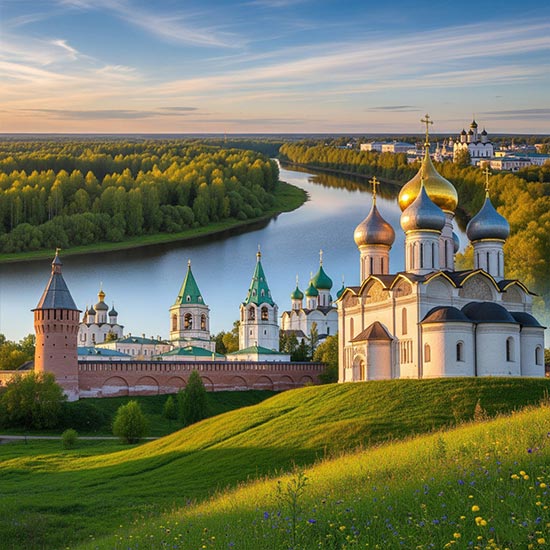
Unlocking Russia’s Past: A Journey Through the Golden Ring
Have you ever wanted to step into a real-life history book, a place where centuries-old churches with shimmering onion domes rise above the landscape and every cobblestone seems to whisper stories of tsars and knights? If so, then let me introduce you to the Golden Ring of Russia. This isn’t just a collection of cities; it’s a curated journey through the very cradle of Russian civilization. Forget the glitz of Moscow and the elegance of St. Petersburg for a moment. The Golden Ring is where you’ll find the soul of Russia, a place where time seems to slow down and the rich tapestry of its history is on full display.
What is the Golden Ring and Why Should You Care?
So, what exactly is the Golden Ring? It’s a popular tourist route that connects a handful of ancient Russian towns and cities northeast of Moscow. The name, which was coined in the 1960s, is no accident it’s a perfect metaphor. These cities form a metaphorical “ring” around the capital, and they’re “golden” because of their immense historical and cultural value. They are the guardians of a pre-Petrine Russia, preserving the nation’s spiritual, architectural, and artistic heritage in a way that no other region can. Visiting the Golden Ring is like getting a backstage pass to the founding of a great empire, a chance to see where it all began.
A Quick Guide to the Cities on the Route
While there’s no single, official list of cities, the core of the Golden Ring typically includes Sergiev Posad, Vladimir, and Suzdal. However, many people also include gems like Yaroslavl, Rostov Veliky, and Kostroma, among others. Each city has its own unique character and a treasure trove of historical sites, from magnificent kremlins and monasteries to humble wooden churches and charming village streets.
Stepping Back in Time: The Birthplace of a Nation
To truly appreciate the Golden Ring, you have to understand its context. These aren’t just pretty towns; they were the nerve centers of medieval Rus’, long before Moscow became the dominant power. This region was the cradle of the Russian state, a place where early princes ruled, Orthodox Christianity took root, and epic battles were fought. The architectural wonders you’ll see aren’t just for show; they are tangible proof of a powerful and thriving civilization that laid the groundwork for modern Russia.
From Princely States to a United Russia
In the 12th and 13th centuries, this region, known as the Vladimir-Suzdal Principality, was one of the most powerful states in what is now Russia. Princes like Andrey Bogolyubsky and Vsevolod the Big Nest built grand cathedrals and fortresses, attracting the finest architects and craftsmen of the time. This period of prosperity saw the rise of a unique architectural style characterized by intricate white-stone carvings and majestic golden domes a style you’ll see repeated in the region’s most famous landmarks.
The Mongol Yoke and the Rise of Moscow
Of course, the region’s history isn’t all glorious. It also bore the brunt of the devastating Mongol invasion in the 13th century. Many of these cities were sacked and burned, a harrowing period known as the “Mongol Yoke.” While the invasion weakened the region, it also set the stage for a new power to rise: Moscow. The princes of Moscow shrewdly allied with the Mongols, slowly consolidating their power and eventually leading the resistance that would finally drive out the invaders and establish a unified Russian state. The Golden Ring cities, once capitals, became quiet guardians of history as the center of power shifted to Moscow.
A City-by-City Guide to the Golden Ring’s Treasures
Now that you know the backstory, let’s dive into the main attractions. While you can’t see everything, hitting the highlights will give you a perfect snapshot of the region’s spirit.
Sergiev Posad: The Spiritual Heartbeat
Your journey often begins in Sergiev Posad, located just outside of Moscow. This is the only Golden Ring city in the Moscow Oblast and it’s a must-visit. The entire town revolves around one magnificent complex: the Holy Trinity St. Sergius Lavra.
The Holy Trinity St. Sergius Lavra: A Living Fortress of Faith
This monastery is to Russian Orthodoxy what the Vatican is to Catholicism a vibrant, active center of faith and a UNESCO World Heritage site. Founded by St. Sergius of Radonezh in the 14th century, the lavra (the highest-ranking type of monastery in Russia) is a sprawling complex of churches, bell towers, and academic buildings. Walking through its walls feels like stepping back in time. You’ll see beautiful churches like the Assumption Cathedral, modeled after its namesake in the Moscow Kremlin, and the Trinity Cathedral, which houses the relics of St. Sergius himself. The lavra isn’t just a museum; it’s a living, breathing place of worship where pilgrims from all over the world come to pray.
Suzdal & Vladimir: The Ancient Capital Duo
These two cities are often visited together because of their close proximity and shared history. They were once the political and cultural core of the principality.
Vladimir: Gates to Glory and Byzantine Beauty
Vladimir was the capital of the medieval Russian state and its former glory is still visible today. The city’s most iconic landmark is the Golden Gate, a 12th-century triumphal arch that once served as the main entrance to the city fortress. It’s a powerful symbol of Vladimir’s past strength. Just as impressive are the Assumption Cathedral and the Demetrius Cathedral, both UNESCO World Heritage sites known for their exquisite white-stone carvings. The Assumption Cathedral, in particular, is a masterpiece of early Russian architecture and was the model for many later churches, including the one in the Moscow Kremlin.
Suzdal: A Postcard from a Fairytale
In contrast to Vladimir’s grand scale, Suzdal feels like a sleepy village that has been perfectly preserved in time. It’s an open-air museum filled with wooden houses, charming shops, and more churches than you can count. The city is famous for its Kremlin, a small but beautiful fortress that houses the Cathedral of the Nativity. But the real magic of Suzdal is in its atmosphere. Wander through its streets, visit the Museum of Wooden Architecture, and see the stunning Saviour Monastery of St. Euthymius. Suzdal truly feels like stepping into a peaceful, rural fairytale.
Yaroslavl: The River Gem
Located on the banks of the mighty Volga River, Yaroslavl is one of the largest and most prosperous cities on the Golden Ring. It’s a perfect blend of rich history and vibrant modern life.
A UNESCO World Heritage Marvel
The historic center of Yaroslavl is a designated UNESCO World Heritage site, a testament to its architectural splendor. The city’s most famous church is the Church of Elijah the Prophet, renowned for its incredible 17th-century frescoes that cover every inch of its interior. You could spend hours just staring at the detailed biblical scenes and vibrant colors. The city is also home to the Spaso-Preobrazhensky Monastery, a stunning fortress-like complex with a beautiful bell tower that offers panoramic views.
Other Jewels on the Ring
The Golden Ring is a flexible route, and if you have more time, it’s worth exploring some of the other fantastic cities.
Rostov Veliky: The Kremlin on the Lake
Rostov Veliky (or “Great Rostov”) is a quieter, more reflective city. Its main attraction is the magnificent Kremlin, a sprawling complex of churches and palaces perched on the shore of Lake Nero. The Kremlin’s elegant bell tower, with its melodious bells, is an iconic sight and has been featured in many Russian films.
Kostroma: Home of the Romanovs
Kostroma, another city on the Volga River, holds a special place in Russian history. It was here that Mikhail Romanov was crowned the first tsar of the Romanov dynasty in 1613. The city’s Ipatiev Monastery is a beautiful monastery and a key site for understanding the end of the “Time of Troubles” and the beginning of the Romanov dynasty.
The Architectural Legacy: A Symphony in White Stone
One of the most striking aspects of the Golden Ring is its unique architectural style. The churches and monasteries here are unlike the later, more Western-influenced architecture you see in St. Petersburg.
From Wooden Churches to Ornate Frescoes
The early churches were often made of wood, and while many have been lost to time, you can still see examples in places like the Museum of Wooden Architecture in Suzdal. However, the most famous style is the white-stone architecture of the 12th and 13th centuries. These structures, like the Church of the Intercession on the Nerl, are masterpieces of grace and proportion, with intricate carvings of real and mythical animals, saints, and foliage. Inside, many of the churches are adorned with stunning frescoes wall paintings that tell biblical stories and are a testament to the skill of the old Russian masters.
The Russian Orthodox Aesthetic
This unique blend of architectural styles and decorative art is deeply rooted in the Russian Orthodox tradition. The magnificent golden onion domes aren’t just for show; they symbolize the flame of a burning candle, a powerful religious metaphor. The intricate carvings and frescoes were not just art but a way to teach religious doctrine to a largely illiterate population. The entire aesthetic is designed to create a sense of awe and spiritual connection, and it succeeds spectacularly.
How to Travel the Golden Ring: Tips for Your Journey
Planning a trip to the Golden Ring can seem daunting, but it’s very manageable. The region is well-connected by train and bus from Moscow, and many travelers choose to hire a private car or join a guided tour.
When to Go and How to Get Around
The most popular time to visit is during the summer (June to August), when the weather is warm and the days are long. The cities are bustling with tourists, and all attractions are open. However, if you’re looking for a quieter, more magical experience, consider going in the winter.
Winter’s Quiet Charm vs. Summer’s Vibrant Life
Winter (December to March) is a special time. The golden domes covered in snow and the frozen rivers create a breathtaking, fairytale landscape. While it will be cold, you’ll have a completely different experience. The Golden Ring is also beautiful in the autumn, when the leaves turn to gold, and in the spring, when the snow melts and the rivers start to flow again. The best way to travel between cities is by train or bus. Distances are short, and the public transport is reliable and affordable.
Why the Golden Ring is a Journey for the Soul
The Golden Ring is more than just a sightseeing tour; it’s a deep dive into the heart of Russia. It’s a chance to see how a nation was forged, to witness the enduring power of faith and art, and to feel the weight of centuries of history. These cities aren’t just museum pieces; they’re living, breathing communities that have stood the test of time. They remind us that true beauty lies not just in modernity, but in the echoes of the past. If you’re looking for a trip that will inspire you and give you a deeper understanding of one of the world’s most fascinating countries, the Golden Ring is waiting for you.
Frequently Asked Questions About the Golden Ring of Russia
1. How long does it take to travel the Golden Ring?
A full tour of the Golden Ring can take anywhere from 3 to 7 days, depending on how many cities you want to visit and how much time you want to spend in each. A quick 3-day tour usually covers Sergiev Posad, Vladimir, and Suzdal, while a longer trip allows you to explore Yaroslavl, Kostroma, and other towns at a more leisurely pace.
2. Do I need to speak Russian to visit the Golden Ring?
While knowing some basic Russian phrases is always helpful, it is not essential. In the main tourist areas and larger hotels, you will likely find English-speaking staff. Many signs and menus also have English translations. However, having a phrasebook or translation app can make things much easier, especially in smaller towns.
3. What is the best way to get around the Golden Ring?
The most common ways to travel are by train or bus. Russian Railways offers good connections between the major cities, and local buses are frequent. Many tourists also choose to hire a private car with a driver or join a guided bus tour for convenience.
4. What kind of food can I expect on the Golden Ring?
You’ll find plenty of traditional Russian cuisine, from hearty soups like borscht and shchi to savory dumplings like pelmeni and vareniki. Don’t miss trying local specialties such as medovukha (a traditional honey-based drink) in Suzdal, and fresh fish from the Volga in Yaroslavl.
5. Is the Golden Ring accessible for travelers with disabilities?
Accessibility for travelers with disabilities can be challenging in the Golden Ring cities, as many of the historical sites, streets, and public transport systems were built long ago and may lack modern amenities like ramps or elevators. It’s best to research specific locations beforehand and consider a guided tour that can accommodate your needs.