
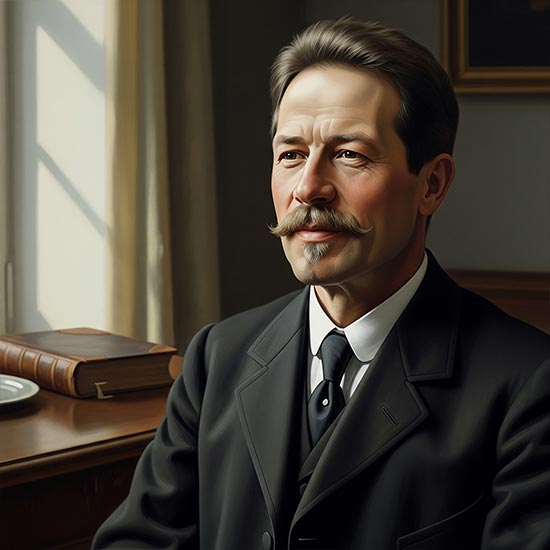
Anton Chekhov Redefined Modern Theater and Short Stories; The Quiet Revolution
Have you ever left a play feeling like nothing happened, yet everything had changed? Or read a short story that felt less like a narrative and more like a stolen glance into someone’s life, a moment of quiet, unspoken truth? If so, you’ve likely experienced the subtle, profound genius of Anton Chekhov. He wasn’t a writer of grand, epic tales or dramatic plot twists. Instead, he was a master of the mundane, a chronicler of everyday life who found profound, universal truths in the quiet disappointments, unfulfilled dreams, and awkward silences of ordinary people. He was a doctor by trade and a writer by calling, and his unique perspective allowed him to diagnose not just the physical ailments of his patients but the spiritual and emotional sicknesses of the human soul. Chekhov didn’t shout; he whispered, and in that whisper, he revolutionized modern literature and theater forever.
A Doctor’s Life, A Writer’s Soul: Chekhov’s Early Years
To understand Chekhov’s unique voice, we must first understand the man himself. Born in Taganrog, Russia, in 1860, he was the son of a grocer and the grandson of a serf. This wasn’t the privileged, aristocratic background of his contemporary, Leo Tolstoy. Chekhov’s early life was marked by hard work and financial hardship. He was an excellent student and eventually earned a scholarship to study medicine at Moscow University.
From Medical Student to Master of the Short Story
While studying medicine, Chekhov began writing short, humorous sketches for magazines to help support his family. He honed his craft by writing countless stories under various pseudonyms, learning to be concise, to capture a moment, and to evoke a mood in just a few pages. He considered his writing a hobby, a side hustle to his “real” profession. What a side hustle it turned out to be! He was incredibly prolific, writing hundreds of short stories that showcased his sharp wit and deep empathy for his characters.
The Burden of Two Professions
Chekhov’s career as a doctor was no mere footnote. It profoundly influenced his writing. He often said, “Medicine is my lawful wife, and literature is my mistress.” His medical practice brought him into direct contact with all strata of Russian society from peasants to aristocrats, from the sick and suffering to the healthy and powerful. He saw human frailty firsthand and was a keen observer of human behavior. This dual life gave his writing a clinical precision combined with a compassionate humanism. He diagnosed human nature the way he diagnosed an illness with an unflinching eye but a deep sense of understanding.
The Literary Landscape: Chekhov’s Unique Style
Chekhov’s genius lies not in what he wrote about, but in how he wrote it. He turned his back on the traditional dramatic conventions of his time, which were often filled with grand speeches, heroic figures, and clear-cut conflicts. Instead, he pioneered a style that focused on the unspoken, the understated, and the emotionally resonant moments of everyday life.
The Art of Subtext: What Isn’t Said is What Matters
If you read a Chekhov play, you’ll notice that the most important conversations often happen off-stage or in the silences between lines. His characters frequently talk at cross-purposes, misunderstanding each other or discussing trivial matters while their hearts are breaking. This is the art of subtext, where the true meaning of a scene lies not in the words spoken but in the emotions boiling beneath the surface. It’s an honest portrayal of human interaction, where we often struggle to articulate our deepest feelings and desires.
The “Chekhov’s Gun” Principle
You might have heard the famous writing principle, “Chekhov’s Gun.” He famously said that if you have a rifle hanging on the wall in the first act of a play, it must be fired by the third act. This simple rule is a cornerstone of his style: every element in a story must serve a purpose. He had no time for unnecessary details or pointless exposition. It’s a testament to his belief in the power of careful observation and meticulous craft. Every detail, no matter how small, adds to the overall emotional weight and atmosphere of the work.
Everyday People, Profound Truths
Chekhov’s characters aren’t heroes or villains; they are ordinary people. They are teachers, doctors, landowners, and artists who are all struggling with the universal human condition. They yearn for love, long for a more meaningful life, and often feel a sense of profound loneliness and disillusionment. By focusing on these quiet, relatable struggles, Chekhov made his work more powerful. He showed us that the greatest drama of all is not a war or a revolution, but the internal battle we fight with ourselves every single day.
Beyond Plot: Focusing on Mood and Atmosphere
While most writers are focused on “what happens next,” Chekhov was more interested in the mood and atmosphere of a scene. His plays, in particular, are known for their melancholy, dream-like quality. The lack of a clear, driving plot can be disorienting at first, but it forces the audience to focus on the emotional texture of the play. We become less concerned with who will end up with whom, and more attuned to the characters’ inner lives and their quiet despair. It’s a style that demands patience but rewards it with a deeper, more profound understanding of the human condition.
The Four Great Plays: A Deep Dive into Chekhov’s Theatrical World
While his short stories are a marvel, Chekhov’s four great plays The Seagull, Uncle Vanya, The Three Sisters, and The Cherry Orchard are what cemented his legacy as a theatrical revolutionary.
The Seagull: Ambition, Love, and Artistic Failure
In The Seagull, Chekhov explores the tragicomic intertwining of unrequited love and artistic ambition. The play revolves around a young writer, Konstantin, and his desire to create a new form of theater, a goal that clashes with his famous actress mother’s more conventional artistic tastes. The play’s tragicomic nature, with characters chasing their dreams only to find disappointment, was a revolutionary departure from the typical melodrama of the time. The play’s initial failure was a crushing blow to Chekhov but a harbinger of a new theatrical age.
The Play That Revolutionized Theater
When it first premiered in 1896, The Seagull was a disaster. The audience, expecting a traditional, plot-driven play, didn’t know how to react to its subtle, naturalistic style. It was only when the play was revived by the legendary Stanislavski at the Moscow Art Theatre that it found its true audience. The Moscow Art Theatre’s commitment to psychological realism and a more understated style of acting was the perfect match for Chekhov’s work, and together, they changed the face of modern theater forever.
Uncle Vanya: Disillusionment and Unfulfilled Dreams
Uncle Vanya is a play about a family trapped in a cycle of boredom, discontent, and unfulfilled potential. The characters are stuck on a rural estate, their lives dominated by a sense of wasted time and missed opportunities. The titular character, Vanya, is a man who has devoted his life to managing the estate for his brother-in-law, a celebrated professor he now believes to be a fraud. The play’s power lies in its quiet portrayal of the slow, creeping despair of a life not fully lived.
The Three Sisters: A Yearning for a Better Life
“To Moscow, to Moscow!” This is the repeated, desperate cry of the three Prozorov sisters in The Three Sisters. Trapped in a provincial town, they long for the excitement and intellectual stimulation of Moscow, a city they idealize as the key to a better, more meaningful life. The play is a heartbreaking exploration of hope, disillusionment, and the tragic gap between what we want our lives to be and what they actually are. It is a powerful reminder that sometimes, the greatest tragedy isn’t what happens to us, but what never does.
The Cherry Orchard: The End of an Era
The Cherry Orchard was Chekhov’s last play and is arguably his most famous. It tells the story of an aristocratic family losing their beloved estate and its beautiful cherry orchard to a more practical, middle-class businessman. The play is a beautiful and poignant elegy for a dying social order in Russia. It’s a play of profound sadness and quiet hope, a beautiful farewell to a world on the brink of change. The orchard itself is not just a setting; it’s a symbol of nostalgia, memory, and the painful necessity of letting go.
The Enduring Legacy of Anton Chekhov
Chekhov died of tuberculosis in 1904, at the young age of 44, but his influence has echoed through the generations. He is a writer’s writer and a playwright’s playwright, revered for his ability to find the universal in the particular.
Influence on Modern Literature and Theater
Chekhov’s legacy can be seen everywhere. His focus on the internal lives of characters and his use of subtext directly influenced writers like Ernest Hemingway and Raymond Carver, who also mastered the art of “less is more.” In theater, the school of psychological realism, epitomized by the work of Konstantin Stanislavski and the Group Theatre in America, is a direct descendent of Chekhov’s plays. Without Chekhov, there would be no Tennessee Williams, no Arthur Miller, and no conversations about the quiet desperation of life on a modern stage.
Why His Works Still Resonate Today
We live in a world of constant noise and overstimulation, a world where everyone is performing for an audience. Chekhov’s work feels more relevant than ever because it cuts through all that. It reminds us of the power of stillness, the importance of listening, and the beauty of human vulnerability. His characters’ struggles with boredom, unfulfilled potential, and a yearning for a more meaningful life are just as relevant today as they were a century ago.
A Mirror to Our Own Quiet Despair and Hope
Chekhov held up a mirror to the human soul and showed us not a glorious hero, but a reflection of ourselves: a little lost, a little sad, but also capable of great love, kindness, and quiet resilience. He showed us that life isn’t always a grand, dramatic story; sometimes, it’s just a series of small, significant moments. And in those moments, we can find truth, beauty, and even a flicker of hope.
Conclusion: The Unspoken Words of a Master
Anton Chekhov was more than a writer; he was a diagnostician of the human heart. He taught us that true drama lies not in explosive events, but in the slow, agonizing process of living. He showed us the profound importance of what goes unsaid, the power of a single look, and the tragedy of a life lived without a purpose. He didn’t offer us a neat, tidy world with happy endings and clear moral lessons. Instead, he gave us a world that feels real—messy, beautiful, and profoundly human. His quiet revolution continues to inspire and challenge us, inviting us to listen not just to the words people speak, but to the silence that lies between them.
Frequently Asked Questions (FAQs)
1. What is the “Chekhov’s Gun” principle?
“Chekhov’s Gun” is a dramatic principle that states every element in a story must serve a purpose. The famous quote, “If in the first act you have hung a pistol on the wall, then in the following one it should be fired,” means that no unnecessary details should be included in a narrative. It’s a rule that emphasizes the importance of conciseness and foreshadowing.
2. How did Chekhov’s career as a doctor influence his writing?
Chekhov’s medical career gave him a unique perspective. He observed human behavior with a clinical eye, seeing firsthand the struggles and ailments of people from all social classes. This gave his characters a sense of psychological realism and authenticity, making his writing a precise and compassionate study of human nature.
3. What makes Chekhov’s plays different from traditional plays?
Chekhov’s plays are often referred to as “subtext plays” because the most significant actions and emotions are not overtly stated. They lack a traditional, dramatic plot with a clear climax. Instead, they focus on the atmosphere, mood, and internal lives of the characters, with dialogue often being a means of miscommunication rather than direct exposition.
4. What is the significance of the “Cherry Orchard” in the play?
The cherry orchard is a central symbol in Chekhov’s last play. It represents the past, memory, and a dying aristocratic way of life. The sale of the orchard symbolizes the end of an era in Russia, as a new, more pragmatic class takes over from the old, ineffective aristocracy. It is a powerful symbol of change and the difficulty of letting go.
5. Why is Anton Chekhov considered a master of the short story?
Chekhov’s short stories are celebrated for their conciseness, psychological depth, and focus on everyday moments. He was a master of the snapshot, capturing a fleeting moment in a character’s life that reveals a profound, universal truth. His ability to evoke mood and emotional resonance in a few pages set a new standard for the genre.