
Alexander Pushkin: The Sun of Russian Poetry and The Enduring Legacy
Have you ever wondered what it takes for a single person to be considered the father of an entire national literature? In Russia, that title belongs, without a doubt, to Alexander Pushkin. He wasn’t just a poet; he was a literary force of nature who arrived like a meteor, blazing a new path for generations of writers to come. Before Pushkin, Russian literature was often seen as a pale imitation of European styles, confined by rigid classical rules. He changed all that. He breathed life into the Russian language, making it flexible, expressive, and capable of conveying the deepest human emotions. His work is a beautiful, vibrant tapestry woven from folklore, history, romance, and searing social commentary. He was a master storyteller, a witty satirist, and a passionate romantic, and his brief, tumultuous life is as legendary as his work.
The Life of a National Poet: From Noble Roots to Turbulent Years
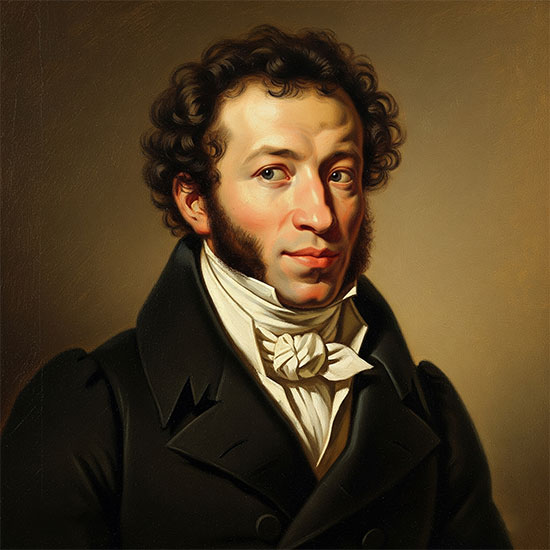
Alexander Sergeyevich Pushkin was born in Moscow in 1799 into an old, though not particularly wealthy, aristocratic family. His lineage was a fascinating mix of Russian nobility and African heritage, a fact that he was immensely proud of. As a young boy, he was exposed to both the refined French culture of his family’s library and the rich, vibrant world of Russian folklore from his nanny, Arina Rodionovna. This blend of European sophistication and Russian earthiness would become a hallmark of his work.
A Prodigy’s Youth and a Rebellious Spirit
Even as a young student at the prestigious Imperial Lyceum at Tsarskoye Selo, Pushkin showed an undeniable poetic gift. He was a lively, energetic boy who quickly became the life of the party, known for his quick wit and sharp tongue. His early poems were full of youthful exuberance and a rebellious streak. He began to associate with intellectuals who were critical of the Tsar’s autocratic rule and his works started to reflect these liberal ideas.
Early Education and Political Activism
The Lyceum was more than just a school; it was a breeding ground for future leaders, thinkers, and artists. Here, Pushkin was educated in a way that encouraged independent thought. His early verses, often circulated in manuscript form, were not just romantic ballads. They were politically charged, filled with calls for liberty and justice. This bold defiance earned him the attention of the Tsar’s government, an attention that would follow him for the rest of his life.
Pushkin’s Poetic Masterpieces: A Journey into His Literary World
While Pushkin is often referred to as a poet, this description doesn’t do him justice. He was a genre-bender, a literary innovator who wrote in every conceivable form, from epic poems and historical dramas to novels in verse and prose tales. Each work was a step forward for Russian literature.
The Romantic Epic: Ruslan and Ludmila
In 1820, Pushkin burst onto the scene with his epic poem, Ruslan and Ludmila. This was a landmark work. It blended elements of Russian fairy tales and folklore with the witty, satirical style of Western romance. The story, which follows a knight’s quest to rescue a kidnapped princess, was a playful, fantastical adventure that delighted readers and critics alike. It was a clear departure from the solemn, classical poetry of the time and signaled the arrival of a new, distinctly Russian voice.
Blending Folklore and Satire
Ruslan and Ludmila wasn’t just a fantasy; it was a testament to Pushkin’s unique vision. He took the characters and stories of his childhood and gave them a fresh, modern twist. He wasn’t afraid to poke fun at the conventions of traditional epic poetry, weaving in witty asides and playful anachronisms. It was a signal that Russian literature could be both deeply rooted in its own culture and at the same time, lighthearted and modern.
The Novel in Verse: Eugene Onegin
If there is one work that defines Pushkin’s genius, it is his novel in verse, Eugene Onegin . Published serially between 1825 and 1832, this work is a breathtaking masterpiece. It tells the story of the titular character, a jaded, cynical young man from St. Petersburg, and his relationship with the sensitive and naive Tatyana Larina. The story is a brilliant commentary on Russian society and the unfulfilled lives of the so-called “superfluous men” aristocratic young men who, lacking any real purpose, are consumed by boredom and disillusionment.
A Portrait of the “Superfluous Man”
Onegin himself is the quintessential superfluous man. He is intelligent and well-read, but he is also emotionally detached and spiritually hollow. Through his character, Pushkin masterfully captures the existential crisis of an entire generation of Russian youth. The novel’s structure, a witty and ironic running commentary by the author himself, makes it feel like an intimate conversation with the reader, a feature that was completely new to Russian literature.
The Historical Drama: Boris Godunov
Pushkin’s foray into historical drama, Boris Godunov (1825), was a direct challenge to the Russian theatrical conventions of his day. Inspired by Shakespeare, he created a grand, sprawling tragedy that depicted the troubled reign of the 16th-century Tsar Boris Godunov. The play was a bold move away from the French classical style and embraced a more realistic and psychologically complex approach.
Shakespearean Grandeur in a Russian Setting
In Boris Godunov, Pushkin focused on historical accuracy and the inner turmoil of his characters. The play is not just about a king; it is a meditation on power, guilt, and the nature of a nation. Though the Tsar’s government was initially hesitant to approve the play for performance due to its historical and political content, its dramatic power and lyrical verse cemented its place as a cornerstone of Russian literature.
The Prose of a Master: Pushkin’s Shift in Focus
In the later part of his career, Pushkin turned his attention more and more to prose, and in doing so, he set the standard for the Russian novel. He believed in the power of clear, concise, and direct language, a stark contrast to the often flowery and convoluted prose of his predecessors.
The Queen of Spades: A Psychological Thriller
The Queen of Spades (1834) is a brilliant, unsettling short story that is a perfect example of Pushkin’s mastery of prose. It’s a psychological thriller about a young man obsessed with a secret a little old countess holds about winning at cards. The story is a chilling look at greed, obsession, and the dark corners of the human mind. Its tight, suspenseful narrative and unforgettable ending have made it a classic of world literature and a favorite of operatic composers.
The Captain’s Daughter: Historical Romance and Honor
The Captain’s Daughter (1836) is another masterpiece of his prose. It is a historical novel set during the Pugachev Rebellion, a peasant uprising in the 18th century. The story is told through the eyes of a young nobleman and is a compelling mix of historical fact and romantic fiction. At its heart, it’s a timeless tale of love, duty, and honor, showcasing Pushkin’s ability to create compelling characters against a backdrop of historical tumult.
The Duel, The Death, and The Legend
Pushkin’s life, as a result of his rebellious nature and outspokenness, was often fraught with danger. He was exiled, monitored by the secret police, and frequently found himself at odds with the Tsar and the rigid social circles of St. Petersburg. His life, filled with duels and controversies, came to a tragic end in 1837.
The Final Years and the Tragic End
His final years were marked by financial struggles and constant surveillance by the government. His beautiful wife, Natalya Goncharova, was the subject of much gossip and the unwanted advances of a French officer, Georges-Charles de Heeckeren d’Anthès. Pushkin’s honor, and that of his family, was at stake. He challenged d’Anthès to a duel.
The Controversy of His Death
On January 27, 1837, the two men met on the outskirts of St. Petersburg. Pushkin was mortally wounded. He died two days later from his injuries. The news of his death sent a shockwave through the nation. His funeral was a somber, heavily policed affair, as the government feared a public display of mourning could lead to an uprising. The circumstances of his death, a great national hero dying in a pointless duel over a personal insult, only added to his legend.
The Enduring Influence of Pushkin
Pushkin’s influence on Russian literature is simply immeasurable. He is the standard by which all other writers are judged, the foundation upon which the great Russian literary tradition was built.
The Father of Modern Russian Literature
He is universally recognized as the founder of modern Russian literature. The great writers who followed him, from Tolstoy and Dostoevsky to Gogol and Lermontov, all revered Pushkin and saw him as their guiding star. He showed them that the Russian language was a rich and powerful tool, capable of expressing every nuance of the human experience. He opened the door for the psychological novels of Dostoevsky and the sweeping epics of Tolstoy.
Pushkin’s Impact on Language and Style
Pushkin’s greatest contribution, perhaps, was his role in reforming the Russian literary language. He rejected the old, stilted, and overly formal style and infused his writing with the clarity, simplicity, and melodic rhythm of everyday speech. He created a language that was both beautiful and accessible, a language that could be used to write everything from a lighthearted folk tale to a profound philosophical novel.
Conclusion: The Undying Flame of Russian Poetry
Alexander Pushkin lived a life of passion, rebellion, and unparalleled creativity. He was a master of words who, in a remarkably short time, completely transformed the literary landscape of an entire nation. His tragic death only solidified his place in the hearts of the Russian people, turning him from a great writer into a national myth. His work is a testament to the power of language, the beauty of the human spirit, and the enduring quest for truth and freedom. He remains, and will forever be, “the sun of Russian poetry,” a light that continues to shine brightly, illuminating the path for all who come after him.
Frequently Asked Questions (FAQs)
1. Why is Alexander Pushkin called the “Father of Russian Literature”?
Pushkin is considered the father of modern Russian literature because he was the first to create a literary language that was both elegant and accessible to a wide audience. He blended various genres and styles, drawing from both European literary traditions and Russian folklore, to create a uniquely Russian voice that was imitated by all subsequent great writers like Tolstoy and Dostoevsky.
2. What is “Eugene Onegin” and why is it so important?
Eugene Onegin is a novel in verse, a genre that Pushkin essentially created. It is significant because it is a brilliant and realistic portrayal of Russian society in the 19th century and introduced the character of the “superfluous man,” a jaded, aimless intellectual who was a recurring figure in later Russian literature. It is also an innovative work for its metrical structure and authorial commentary.
3. What is the significance of Pushkin’s duel?
Pushkin’s duel is a key part of his legend. He was mortally wounded in a duel with his brother-in-law, d’Anthès, over the honor of his wife. The duel is seen as a tragic and symbolic end for a great man who lived and died by the very codes of honor and passion he often explored in his work.
4. How did Pushkin’s heritage influence his writing?
Pushkin was a descendant of an African general who served under Peter the Great. This heritage was a source of great pride for him, and he often referenced it in his works. It gave him a unique perspective and set him apart from the more homogeneous literary circles of his time.
5. What is the “Pushkin’s Gun” principle?
While not a formal “principle” like Chekhov’s, Pushkin’s writing is characterized by its economy and directness. He avoided the long, flowery descriptions common in his time. His prose, especially in works like The Queen of Spades, is known for being lean, purposeful, and focused on the story at hand.