
Moscow Metro: An Underground Palace of Soviet Art and Engineering
Have you ever imagined a subway system that is a destination in itself? A place where every station is a masterpiece, adorned with marble, mosaics, and breathtaking chandeliers? Well, that’s not a fantasy; it’s the Moscow Metro. While it serves as the city’s primary mode of public transportation, carrying millions of passengers every day, it’s also a vast, subterranean museum. Its grandeur and scale are unlike anything you’ve ever seen. But why was such an extravagant system built, and which stations should you make sure not to miss? Let’s take a deep dive into this extraordinary underground world.
More Than Just a Subway System
To understand the Moscow Metro, you have to look beyond its function as a way to get from point A to point B. It was conceived as a political and social statement, a symbol of a new era.
The “Palaces for the People” Concept
During the Soviet Union, Joseph Stalin and the Communist Party had a very specific vision for the metro: it would be “palaces for the people.” The idea was that ordinary workers should be able to travel through spaces that were as beautiful and grand as any palace or church. This was a form of Socialist Realism, an artistic style that glorified the achievements of the Soviet state and its working class. The lavishness wasn’t just for show; it was a form of political propaganda, a promise of a better, more glorious future.
A Legacy of Grandeur
The stations were designed by some of the Soviet Union’s most talented architects and artists. They used the finest materials, from different types of marble and granite to bronze sculptures and stained glass. This commitment to grandeur has made the Moscow Metro an enduring legacy. It’s a powerful metaphor: the everyday person, the worker, is the foundation of society, and they deserve to be surrounded by beauty.
A Journey Through Time: History of the Moscow Metro
The story of the Moscow Metro is the story of Soviet power, a reflection of the nation’s triumphs and tragedies.
The Vision of Lazar Kaganovich
The construction of the metro was a massive undertaking, spearheaded by Lazar Kaganovich, a close associate of Stalin. He was a ruthless and brilliant administrator who was given the task of creating a world-class subway system from scratch. Kaganovich saw the project not just as an engineering challenge but as a way to demonstrate the superiority of the Soviet system. He pushed for speed, efficiency, and above all, stunning aesthetics.
The First Lines and the Age of Expansion
Construction began in the early 1930s. The first line, the Sokolnicheskaya line, opened in 1935, stretching from Sokolniki to Park Kultury. It was an instant sensation, a symbol of Soviet progress. The network grew rapidly, with new lines and stations being added regularly. The deep stations were a particular engineering marvel, some located more than 80 meters (260 feet) underground due to the city’s complex geology and for strategic purposes.
The Circle Line: The Gilded Ring
The most famous part of the system is arguably the Circle Line, or Koltsevaya liniya. Built after World War II, this line is a veritable ring of stunning stations, each one a different tribute to a Soviet hero or achievement. This line is often recommended as the perfect way to see the most impressive stations without getting lost, as it’s a closed loop. It truly is the gilded ring of the Moscow Metro.
The Impact of World War II
During World War II, the metro played a crucial role. The deep stations were used as bomb shelters, protecting hundreds of thousands of Muscovites from air raids. The trains continued to run, and the stations provided a safe, if temporary, home for the city’s residents. It was a testament to the system’s robust construction and its importance to the life of the city.
The Most Beautiful Stations: Art, Culture, and Propaganda
If you only have time to visit a few stations, make sure they are these. They are the best examples of the metro’s artistic and architectural grandeur.
A Showcase of Socialist Realism
The art and design within the stations were not random; they were a deliberate expression of Socialist Realism. The mosaics, sculptures, and frescoes all depicted scenes of a perfect Soviet life: happy workers, heroic soldiers, and thriving agriculture. The art was meant to inspire, to educate, and to reinforce the state’s ideology.
Komsomolskaya Station
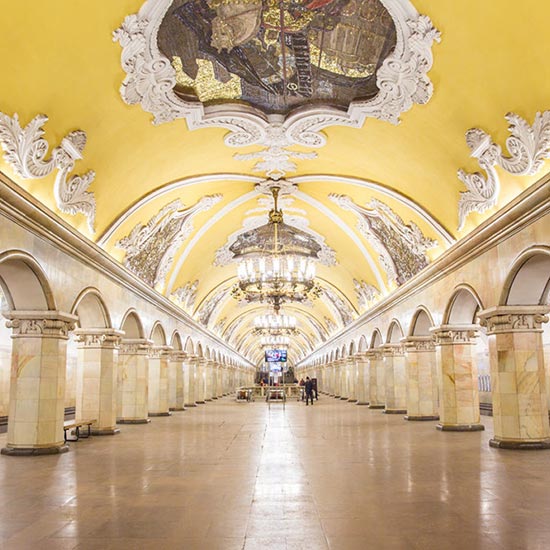
This station is often considered the most beautiful in the entire system. Designed in the ornate style of Stalinist Empire architecture, its ceiling is a tapestry of massive mosaics depicting heroic moments in Russian history and the fight for independence. The intricate chandeliers and marble columns make you feel like you’ve just stepped into a palace. It’s a truly jaw-dropping sight.
Mayakovskaya Station
Named after the great Soviet poet Vladimir Mayakovsky, this station is a masterpiece of Art Deco design. Its elegant, streamlined arches and columns are a tribute to modernism. The ceiling is decorated with dozens of mosaics depicting “A Day in the Soviet Sky,” showing airplanes, parachutes, and triumphant athletes. It’s a beautiful blend of art, poetry, and technology.
Elektrozavodskaya Station
This station, whose name means “electrical factory,” is a celebration of Soviet industry. Its magnificent vault is decorated with thousands of incandescent bulbs, arranged in a way that creates a stunning visual effect, as if you’re standing in a luminous tunnel. The walls are lined with marble reliefs of electrical workers, soldiers, and scientists, all working together for the betterment of the state.
Hidden Details and Secret Tunnels
Beyond the public spectacle, the Moscow Metro has its own set of legends and secrets.
The Legend of Metro-2
Perhaps the most famous story is that of Metro-2, a supposed secret, parallel subway system for the government and military elite. While the existence of this system has never been officially confirmed, it’s a popular urban legend, fueling theories of secret bunkers, hidden tunnels, and a shadow network reserved for those in power. It’s a testament to the fact that the Moscow Metro is a place of mystery as well as grandeur.
Navigating the Moscow Metro Like a Local
The system can seem a little intimidating at first, but with a few tips, you’ll be navigating it like a pro.
Essential Tips for First-Timers
The key to a successful metro tour is to not get overwhelmed. Focus on visiting just a few of the most famous stations at a time. A great strategy is to take the Circle Line, which connects many of the most beautiful stations, making it easy to hop on and off. Don’t be afraid to ask for help; while English isn’t universally spoken, many young people are happy to assist.
Using the Metro System: Tickets and Navigation
Moscow’s metro is modern and efficient. You can buy tickets from vending machines or ticket counters. A single ride is affordable, and you can also get a rechargeable card, the Troika card, which is the most convenient option. The signage is in both Russian and English in the central stations, which makes navigation much easier for tourists. And always remember to stand on the right on the escalators—they are some of the longest and deepest in the world!
Conclusion: An Experience to Remember
The Moscow Metro is so much more than a transportation network. It’s a breathtaking art gallery, a monument to a forgotten ideology, and a symbol of human ambition. It tells a story of a nation’s history, its triumphs, and its unique artistic vision. When you ride the metro, you’re not just commuting; you’re traveling through a piece of living history. So next time you find yourself in Moscow, don’t just admire the sights above ground. Head underground and discover a world of beauty, history, and wonder that will stay with you long after you’ve left.
Frequently Asked Questions (FAQs)
What is the best station to start my metro tour?
A great place to start your tour is Komsomolskaya station (Line 5, Circle Line), as it is arguably the most famous and beautiful. From there, you can easily travel around the Circle Line to see other magnificent stations like Mayakovskaya and Novoslobodskaya.
Is it difficult to navigate the Moscow Metro as a tourist?
While it may seem daunting, it’s actually quite manageable. Many of the central stations have signs in both the Cyrillic and Latin alphabets. The metro map is color-coded and easy to read. A great tip is to download a Moscow Metro app on your phone, which can help with directions even without an internet connection.
How deep is the Moscow Metro?
The Moscow Metro is one of the deepest subway systems in the world. The average depth is about 24 meters (79 feet), but some stations, particularly on the deep-level lines, are much deeper. The deepest station, Park Pobedy, is an incredible 84 meters (276 feet) underground.
Are the metro stations open 24/7?
No, the Moscow Metro is not open 24 hours a day. It typically operates from around 5:30 a.m. until 1:00 a.m. The exact times may vary by line and day of the week, so it’s always best to check the official schedule if you’re traveling late at night.
Is it safe to ride the Moscow Metro at night?
Yes, the Moscow Metro is generally considered very safe, even at night. The stations and trains are well-lit, and there are always plenty of people around. Security presence is also common, both on platforms and in trains. You should, of course, always be aware of your surroundings, just as you would in any major city.