
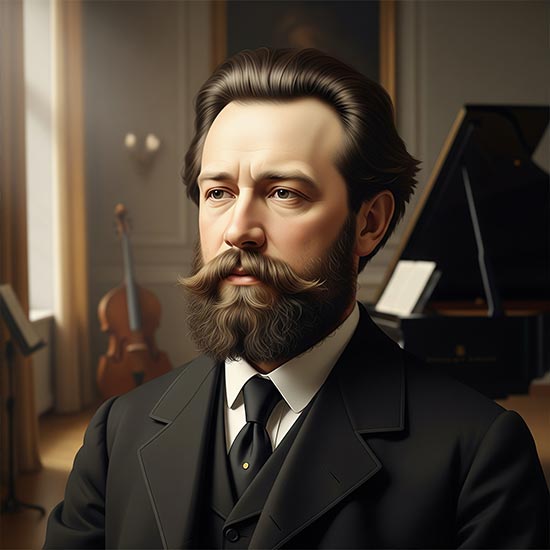
Pyotr Ilyich Tchaikovsky, The Melancholy Maestro: A Journey into the Heart of Russian Romanticism
Have you ever listened to a piece of music that completely takes over your emotions, a melody so beautiful and so sad that it feels like it’s speaking directly to your soul? If so, there’s a good chance you were listening to the work of Pyotr Ilyich Tchaikovsky. He was a composer who didn’t just write music; he bled his emotions onto the page. His work is a fascinating contradiction: it’s some of the most beautiful and accessible music ever written, yet it’s filled with a raw, often painful, emotional honesty. He was a man who lived a life of secrets and inner turmoil, and that turmoil is the very lifeblood of his compositions. He gave us the soaring joy of The Nutcracker and the heartbreaking despair of the “Pathetique” Symphony. He was the poet of the orchestra, a true giant of Russian Romanticism who proved that music, at its best, is a direct line from one human heart to another.
The Early Years: A Life of Unlikely Beginnings
To understand Tchaikovsky’s music, you have to understand the man behind the notes. His was not a straightforward path to musical greatness; it was a winding road filled with detours and profound personal struggles.
A Childhood of Privilege and Pressure
Born in 1840, Tchaikovsky came from a well-to-do family. His father was an engineer, and his mother was a cultivated woman with a talent for singing and playing the piano. His childhood was one of comfort and cultural enrichment. He began piano lessons at the tender age of five, and it was clear from a very young age that he had an exceptional musical talent. But this talent wasn’t seen as a viable career path. Instead, his family pushed him towards a more “respectable” profession: the law.
The Legal Career That Never Was
At the age of 10, Tchaikovsky was sent to St. Petersburg to study at the Imperial School of Jurisprudence, a prestigious boarding school that trained young men for careers in the civil service. He spent nine years there, an experience he would later describe as deeply lonely and unhappy. He found the legal studies tedious and stifling. While his mind was being trained for the law, his heart was still firmly in the world of music. He would attend the opera and the ballet whenever he could, and he would often play music with his friends. The law was his family’s expectation, but music was his soul’s calling.
The Call of Music: A Late Bloomer’s Journey
After graduating and getting a post at the Ministry of Justice, Tchaikovsky found himself miserable. He finally made a decision that would change the course of his life and the history of music: at the age of 21, he resigned from his post and enrolled in the St. Petersburg Conservatory. By professional standards, he was a late bloomer. Most composers who achieve his level of fame begin their formal training much earlier. But Tchaikovsky’s late start was perhaps his greatest strength. It meant that his musical voice was entirely his own, unburdened by the strictures of a rigid, early training. It was in the conservatory, under the guidance of Anton Rubinstein, that he found his true purpose and began the journey that would make him a global icon.
The Tchaikovsky Style: Melancholy, Melody, and Emotional Extremes
So, what is it that makes a piece of Tchaikovsky’s music so unmistakably his? It’s a combination of profound emotional depth, a stunning gift for melody, and a willingness to explore the full spectrum of human feeling, from the most blissful joy to the deepest despair.
The Power of Melody and Lyrical Expression
Tchaikovsky was, above all else, a master melodist. His music is filled with melodies that are so beautiful, so memorable, and so emotionally resonant that they can move you to tears. He believed that a melody should be a lyrical, almost song-like expression of a single emotion. Think of the famous theme from Swan Lake or the haunting melody from the Symphony. These are not just musical phrases; they are emotional statements, pure expressions of sorrow, longing, or love.
The Fusion of Russian and Western Traditions
Tchaikovsky’s music is a fascinating bridge between two worlds: the Russian musical tradition and the Western European Romantic tradition. He was a great admirer of Western composers like Mozart and Beethoven, and his music is built on the classical forms and harmonic structures of the West. But he infused this classical framework with a distinctly Russian soul. He used melodies inspired by Russian folk songs, and he imbued his music with the characteristic melancholy and dramatic intensity of Russian literature and art. This fusion of two traditions gave his music a unique and unforgettable sound.
The Emotional Rollercoaster of His Compositions
When you listen to a Tchaikovsky piece, you’re not just listening to music; you’re going on an emotional journey. His symphonies, in particular, are like a rollercoaster ride. They can swing wildly from moments of soaring triumph to periods of crushing sadness. He wasn’t afraid to explore the darkness, the sadness, and the anxiety that he felt in his own life. In fact, he embraced it, using his music as a canvas for his most profound and intimate feelings. This emotional honesty is what makes his music so powerful and so relatable.
A Mirror to a Tormented Soul
Many music historians believe that Tchaikovsky’s personal struggles particularly his secret homosexuality and his constant battles with depression and anxiety were the wellspring of his creative genius. His music is a direct reflection of his inner life. The turbulent, dramatic climaxes of his symphonies and the aching sadness of his lyrical melodies are, in a sense, a mirror to a tormented soul. He was a man who felt things so deeply that he had to express them in the only way he knew how: through music.
The Ballet Triumvirate: A Legacy of Iconic Dance
While he wrote masterful symphonies, concertos, and operas, Tchaikovsky is perhaps most beloved for his three great ballets. They are a triumph of storytelling and musical genius, a cornerstone of the global ballet repertoire.
Swan Lake: The Poetic Tragedy
Swan Lake is Tchaikovsky’s first ballet and, for many, his most iconic. It’s a story of love, betrayal, and a curse that turns a beautiful princess into a swan. When it first premiered, it was a flop. The dancers and the orchestra were not up to the challenge of his complex and demanding score. But after his death, a revised production revealed the ballet for the masterpiece it truly was. The music, with its soaring melodies and haunting romanticism, has become a symbol of classical ballet itself.
The Iconic “Dance of the Little Swans”
Who hasn’t heard the famous “Dance of the Little Swans”? This piece, with its simple, playful melody and its perfectly synchronized choreography, has become a global pop culture icon. But beyond this single piece, the ballet’s score is a masterpiece of storytelling. Tchaikovsky used different musical themes to represent the characters and their emotions, creating a musical narrative that is as powerful as the dance itself.
The Nutcracker: A Christmas Tradition
The Nutcracker is arguably Tchaikovsky’s most famous work, a beloved holiday tradition for families around the world. It’s a magical, fairy-tale journey through the land of sweets, and the music is pure joy. From the whimsical “Dance of the Sugar Plum Fairy” to the majestic “Waltz of the Flowers,” the score is a collection of some of the most beautiful and enchanting melodies ever written.
The Magical World of Childhood Imagination
Unlike the dramatic and often sad themes of his other works, The Nutcracker is a pure celebration of childhood wonder and imagination. Tchaikovsky’s score perfectly captures the magical world of the story, using different instruments to evoke the sounds of a toy soldier, a sugar plum fairy, and a waltzing flower. It’s a reminder of his versatility, his ability to write music that is both deeply emotional and incredibly charming.
Sleeping Beauty: A Fairy-Tale of Grandeur
Tchaikovsky’s final ballet, Sleeping Beauty, is a grand, sweeping, and majestic masterpiece. It’s a full-length, four-act ballet that is a pure celebration of the classical ballet tradition. The score is a symphony of elegance and grace, filled with beautiful melodies and lush orchestrations. It’s a work that shows Tchaikovsky at the height of his powers, a composer in complete command of his craft.
Symphonies and Operas: A Deep Dive into Passion
While the ballets are his most famous works, it is in his symphonies and operas that we truly get to see the depth of Tchaikovsky’s soul. They are a deep dive into his passions, his fears, and his deepest philosophical questions.
Symphony No. 6, “Pathetique”: A Cry from the Soul
The “Pathetique” Symphony is arguably Tchaikovsky’s greatest masterpiece. It is his last major work, and he conducted its premiere just nine days before his sudden death. The symphony is a cry from the soul, a profound and deeply personal work that grapples with themes of fate, death, and despair. The final movement, which ends in a quiet, fading despair, is one of the most heart-wrenching and powerful pieces of music ever written.
The Final Farewell in Music
Many people believe that the “Pathetique” was Tchaikovsky’s final farewell, a musical epitaph for a life filled with emotional turmoil. The symphony is a perfect example of his emotional extremes. It moves from moments of great passion and fury to a final, tragic acceptance of his own fate. It’s a work that is both incredibly sad and incredibly beautiful, a testament to a man who, in his final days, was able to turn his pain into art.
Eugene Onegin: The Opera of Missed Chances
Tchaikovsky’s most famous opera, Eugene Onegin, is a masterpiece of dramatic and musical storytelling. It’s a story of unrequited love, betrayal, and a series of missed chances. The opera is based on a famous novel by Pushkin, and Tchaikovsky, with his gift for psychological insight, perfectly captures the emotional nuance of the characters. He famously said he wrote it with “my heart full of a feeling of love.”
The Unsent Letter and a Timeless Regret
The most famous scene in the opera is the “Letter Aria,” where the heroine, Tatyana, writes a heartfelt letter to Onegin confessing her love for him. The aria is a stunning piece of music, a passionate and dramatic expression of love that is both deeply personal and universally relatable. The opera, with its themes of lost love and regret, is a perfect reflection of Tchaikovsky’s own emotional landscape.
A Life of Secrets and Support
Tchaikovsky’s life was also shaped by a series of unusual and complex relationships, which provided him with both creative freedom and immense personal pressure.
The Enigmatic Patroness: Nadezhda von Meck
One of the most fascinating relationships in Tchaikovsky’s life was with Nadezhda von Meck, a wealthy widow and a passionate lover of his music. They had a patronage agreement: she would provide him with a generous annual stipend, allowing him to focus entirely on his composition, on one condition—they would never meet. They exchanged more than 1,200 letters over a period of 13 years, and their relationship became a deep, emotional, and intellectual bond, a love affair of the mind.
A Love Affair of the Mind and Art
The letters they exchanged provide a fascinating window into Tchaikovsky’s life, his creative process, and his personal struggles. He poured his heart out to her, and she, in turn, provided him with the financial and emotional support he needed to create his greatest works. Their relationship was a testament to the power of art to connect two souls, even when they are separated by an ocean of distance. .
The Weight of Secrecy: Personal Demons and Societal Pressure
Despite his immense public success, Tchaikovsky’s personal life was a source of constant anguish. He was a homosexual in a deeply conservative and homophobic society. He lived in constant fear that his secret would be exposed, and this fear contributed to his frequent bouts of depression and anxiety. His brief and disastrous marriage was an attempt to conform to societal expectations and to escape the rumors that swirled around him, but it only brought him more pain. This profound personal struggle is what makes his music so emotionally resonant and so deeply human. He was a man who knew what it felt like to be an outsider, and that experience gave his music a sense of longing and melancholy that is unique and unforgettable.
Conclusion: The Unforgettable Echo of a Melancholy Maestro
Pyotr Ilyich Tchaikovsky was a man of immense talent and profound sorrow. He was a composer who found his greatest joy in the act of creation and his deepest pain in the secrets he was forced to keep. He took the drama of his own life and transformed it into a legacy of music that is both deeply personal and universally accessible. His work reminds us that art is not just about beauty; it is about honesty. It is about taking the full spectrum of human emotion, from the soaring heights of love to the crushing depths of despair, and turning it into something beautiful. His music is a permanent monument to a man who lived a life of quiet suffering, but whose artistic voice roared with a passion that can never be silenced.
Frequently Asked Questions (FAQs)
1. Why is Tchaikovsky considered a “late bloomer” as a composer?
Tchaikovsky is considered a late bloomer because he did not begin his formal music studies until the age of 21, which is much later than most other composers of his stature. He had initially pursued a career in law to please his family, but he eventually abandoned it to follow his passion for music.
2. What was the relationship between Tchaikovsky and Nadezhda von Meck?
Nadezhda von Meck was Tchaikovsky’s wealthy patroness who provided him with a generous stipend for 13 years, allowing him to dedicate himself to composing. Their relationship was a unique one: they never met in person but maintained a close emotional and intellectual bond through an extensive correspondence of more than 1,200 letters.
3. What is the significance of the “Pathetique” Symphony?
The “Pathetique” Symphony is Tchaikovsky’s last major work and is considered one of his greatest masterpieces. It is a profoundly emotional piece that is widely interpreted as a reflection of his struggles with depression and his feelings about fate and death. Its somber final movement is particularly famous for its powerful and melancholic conclusion.
4. Why are Tchaikovsky’s ballets so famous?
Tchaikovsky’s ballets are famous because they represent a perfect fusion of music and dance. His scores for Swan Lake, The Nutcracker, and Sleeping Beauty elevated ballet music from a mere accompaniment to a work of art in its own right, filled with memorable melodies, rich orchestration, and emotional depth that perfectly tells the story on stage.
5. How did Tchaikovsky’s personal life influence his music?
Tchaikovsky’s personal life, particularly his struggles with his sexuality and bouts of depression, had a profound influence on his music. The emotional extremes, melancholy, and passionate intensity found in his compositions are often seen as a direct reflection of his inner turmoil and the pain of living a life of secrecy in a conservative society.