
Father Sergei Tolstoy Summary
A Comprehensive and Complete Summary of Tolstoy’s Father
Have you ever wondered what it would be like to have one of the world’s greatest minds as your parent? To see beyond the public image and witness the genius, the flaws, and the daily contradictions? That’s the incredible gift we’re given in Sergei Tolstoy’s remarkable book, “Tolstoy Remembered by His Son,” often simply referred to as “Father.” This isn’t just another biography; it’s a deeply personal, intimate, and often painfully honest account of Leo Tolstoy, written by his own son. While others wrote about the great writer, Sergei lived with him, worked with him, and was a direct witness to his spiritual and personal struggles. If you want to truly understand the man behind the myths, this is the book you need. Let’s explore the profound journey Sergei takes us on.
Beyond the Legend: The Intimate Portrait by His Son, Sergei
Unlike a traditional, objective biography, Sergei’s book is a collection of memories, anecdotes, and reflections. It’s a memoir that places us directly in the heart of the Tolstoy family home, Yasnaya Polyana, and allows us to see the legendary author not as a monument, but as a person a father, a husband, a friend, and a profoundly complicated individual. This unique perspective is what makes the book so invaluable.
The Context: Unveiling the Man Behind the Masterpieces
By the time he was writing this, Sergei had a unique vantage point. He had a deep love and respect for his father, but he also held a keen awareness of the paradoxes in his life. He saw the genius who wrote “War and Peace,” but also the eccentric man who tried to live like a peasant. He witnessed the public adoration but also the private battles that tore his family apart. It’s this blend of admiration and critical distance that makes Sergei’s account so compelling. He’s not here to idolize his father; he’s here to understand him.
A Unique Perspective: Why This Biography Matters
So many biographies of Leo Tolstoy are based on letters, diaries, and secondhand accounts. But Sergei’s is a primary source. He was a close confidant, an observer, and sometimes a participant in his father’s most significant life events. We hear about the games they played, the arguments they had, and the silent moments of connection. This book gives us the raw, unvarnished truth of a family’s life with a revolutionary mind, and for that reason alone, it’s an essential read for anyone fascinated by the great writer.
Part I: The Early Years and The Family Man
Sergei’s book begins by taking us back to his own childhood, painting a picture of a man who was, in his own way, as much a part of the Russian landscape as the books he wrote.
A Father’s Contradictions: From Baron to Peasant
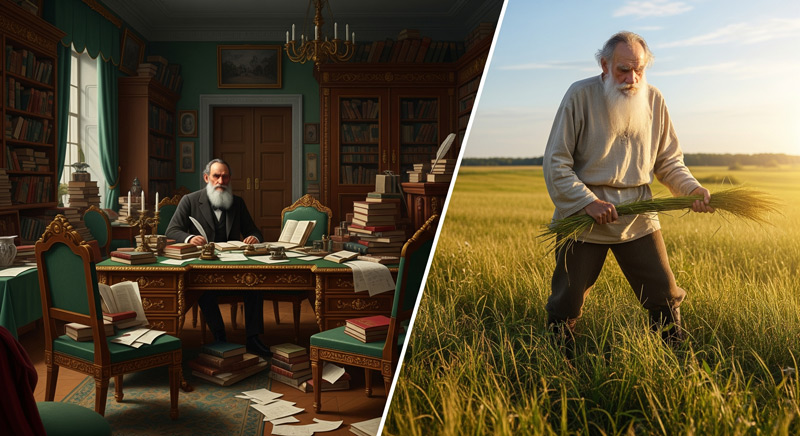
One of the most powerful themes in the book is the constant push and pull between Leo Tolstoy’s aristocratic origins and his embrace of a simple, peasant lifestyle. Sergei recalls how his father would spend hours in his study writing, only to then go out into the fields and plow the land with the local peasants. This was not a performance; it was a deeply held conviction.
The Gentleman and the Farmer
Sergei describes how his father, a man born into a world of privilege and comfort, came to believe that true morality and spiritual fulfillment could only be found through manual labor. He would often be seen wearing peasant clothing, his hands calloused from work. This was bewildering to the family and to the guests who came to visit. It showed a man who was a living contradiction, a nobleman who had rejected his own class and was trying to build a new life based on his beliefs.
The Educator and the Philosopher
Tolstoy’s role as an educator is also a key part of Sergei’s account. He describes his father’s educational experiments at Yasnaya Polyana, where he created a school for the peasant children. Leo believed that education should be a liberating, joyful experience, not a rigid, punitive one. Sergei’s memories of this time show a man who was not only a deep thinker but also a hands-on, passionate teacher who was always searching for a better way to live and to learn.
The Complex Marriage with Sonya Andreevna
Sergei’s book provides an intimate look at the tumultuous and passionate relationship between his father and his mother, Sonya. This is perhaps one of the most painful and honest parts of the biography. Sergei paints a portrait of two people who loved each other deeply but were ultimately torn apart by their conflicting views on life.
Love, Art, and Resentment
Sergei writes about the early years of his parents’ marriage, a time of great love and artistic collaboration. Sonya was not only Tolstoy’s wife but also his secretary, copying and editing his manuscripts for hours on end. She was his confidante and a central part of his artistic process. But as Tolstoy’s spiritual beliefs became more radical, the love they shared was overshadowed by resentment. Sonya believed that his new ideals were a betrayal of his family, and she grew to resent his rejection of the wealth and fame she felt were essential to their lives.
Part II: The Spiritual Crisis and its Fallout
This is the central theme of the book. Sergei’s account of his father’s spiritual crisis is a fascinating and often heartbreaking look at a man who was willing to sacrifice everything for his beliefs.
The Inner Turmoil: A Soul on Fire
Sergei describes the years of his father’s spiritual turmoil with a unique understanding. He saw his father grappling with questions of faith, mortality, and the meaning of life. This was not a sudden change but a gradual, painful process that left the entire family feeling unsettled and confused. Leo was no longer just a writer; he was a prophet, a man on a mission to live his truth, no matter the cost.
The Rejection of Worldly Fame and Wealth
Sergei remembers how his father, after writing some of the most famous novels in history, came to view his literary works as worthless. He saw them as products of vanity and ego, and he rejected the fame and money they brought him. This was incomprehensible to the family, especially to his mother, who had managed the family’s finances and believed the wealth was essential for their survival and for their children’s futures.
The New Path: From God to Christian Anarchism
Tolstoy’s new path was radical. He embraced a form of Christian anarchism, which called for non-violence, a rejection of government, and a return to a simple, moral life. He believed in a direct, personal relationship with God and rejected the organized church, which he saw as corrupt and hypocritical. Sergei recounts the many passionate debates his father had with religious and political figures, showing a man who was fearless in his convictions.
The Family Divided: A House of Conflicting Ideals
The conflict between Tolstoy’s beliefs and his family’s way of life became unbearable. Sergei describes the family home as a battleground of conflicting ideals. His father, the head of the house, was preaching a message of poverty and simplicity, while his family was still living a life of comfort and luxury. This created an impossible situation.
The Schism Over Property and Writings
The most significant conflict was over the family’s finances and the rights to Tolstoy’s writings. Leo believed that his works belonged to the people and should be published for free. He wanted to give up his copyrights and his land. Sonya, however, fought him on this. She saw the copyrights as her children’s inheritance and believed that her husband’s actions were reckless and unfair to the family. Sergei’s account of this schism is particularly poignant, as he clearly loves and respects both his parents and tries to understand both of their perspectives.
Part III: The Final Years and The Tragic End
Sergei’s book takes a particularly heartbreaking turn as he recounts the final years of his father’s life.
The Growing Chasm Between Father and Family
The last years were filled with sadness and tension. Tolstoy, feeling increasingly misunderstood and stifled by his family, began to withdraw. His health was failing, and he longed for a life of true simplicity. He found his family’s love of luxury and their constant arguments over his will unbearable. He felt like a prisoner in his own home.
The Last Journey and The Final Goodbye
Sergei recounts the famous story of his father’s final, desperate flight from home. On a cold October night, Tolstoy left his family with only a few possessions, hoping to find a place where he could live in peace and die in solitude. This was a final, tragic act of a man who could no longer reconcile his beliefs with his reality. Sergei describes the frantic search for his father and the heartbreaking moment he found him, a man broken and ill, at the small train station of Astapovo.
The Legacy of a Human Struggle
Sergei’s book does not end with a neat conclusion. It ends with a deep sense of sadness and a lasting understanding of the human tragedy that was his father’s life. The final pages of the book are a moving tribute to a man who, for all his genius, was still just a human being grappling with the same questions we all face.
Thematic Analysis: Key Insights from a Son’s Eyes
Sergei’s biography offers unique insights into some of the most important themes of Tolstoy’s life and work.
The Battle Between Belief and Reality
The book is a powerful testament to the struggle between a man’s ideals and the harsh realities of life. Tolstoy’s beliefs were radical and beautiful, but they were also incredibly difficult to live out in the real world. His life was a constant battle between his spiritual convictions and the practical demands of his family and society.
The Human Cost of Uncompromising Ideals
Sergei shows us that his father’s uncompromising idealism came at a great personal cost. It alienated him from his family and brought him great personal suffering. The book reminds us that even the most beautiful ideas can be destructive if they are pursued without empathy and understanding for those we love.
A Son’s Love and Frustration
What makes this biography so powerful is the clear love and deep frustration that Sergei felt for his father. He understood and admired his father’s genius and his convictions, but he also saw the pain they caused. His perspective is a human one, a loving son trying to make sense of a man who was both a loving parent and a spiritual revolutionary.
Conclusion: The Unforgettable Portrait of a Human Being
“Father” is a masterpiece of biographical writing. It is an honest, compassionate, and deeply personal account of one of history’s most celebrated figures. It takes him off his pedestal and shows us the man behind the legend a man of profound genius, but also a man of immense contradictions and human struggles. This book is a powerful and necessary read for anyone who wants to understand not just what Tolstoy wrote, but what he believed and how he lived. It’s an unforgettable look at a great mind, a complex family, and the profound, universal struggle to find a life of purpose and authenticity.