
War and Peace Tolstoy Summary
A Comprehensive and Complete Summary of Tolstoy’s War and Peace
Have you ever looked at a massive novel and felt a mix of awe and intimidation? That’s exactly how many of us feel when we first encounter Leo Tolstoy’s masterpiece, “War and Peace.” It’s not just a book; it’s a whole universe of its own, spanning multiple generations, intense battles, and profound philosophical questions. If you’ve ever wanted to tackle this epic but felt overwhelmed, you’re in the right place. We’re going to break down the sprawling narrative of “War and Peace” and guide you through its rich, complex world, making its 1,200+ pages feel a little less daunting. Think of this as your personal tour guide to one of the greatest novels ever written.
The Grand Tapestry: Why “War and Peace” Still Matters
Before we dive into the nitty-gritty of the plot, let’s talk about why this book has held its place in the literary canon for over a century. It’s more than just a historical novel about the Napoleonic Wars. Tolstoy masterfully weaves together the personal stories of his characters with the vast, impersonal forces of history. He explores themes that are just as relevant today as they were in the 19th century: the search for meaning, the nature of love, the futility of war, and the tension between individual free will and historical determinism. It’s a book that truly has something for everyone, whether you’re a history buff, a romance novel fan, or a deep-thinking philosopher.
The Historical Backdrop: Europe in the Age of Napoleon
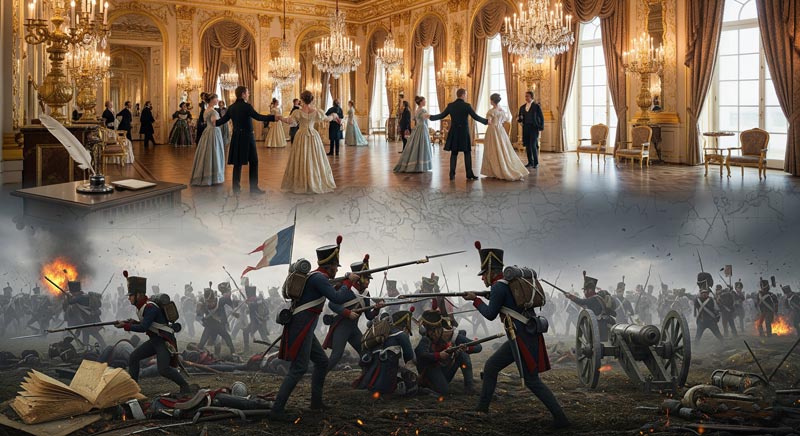
“War and Peace” is set between 1805 and 1812, a pivotal time in European history. Napoleon Bonaparte had crowned himself emperor of France and was busy conquering most of the continent. Russia, under the reign of Tsar Alexander I, was in a state of constant conflict, sometimes allied with, but mostly at war with, Napoleon’s forces. This period provides the dramatic stage for our story, with its grand balls and peaceful country estates often juxtaposed with the chaos and brutality of the battlefield. It’s this stark contrast that truly defines the narrative.
The Core Characters: A Guide to the Main Players
Tolstoy’s world is populated by a large cast of characters, but the story primarily revolves around three aristocratic families: the Bolkonskys, the Bezukhovs, and the Rostovs. Getting to know them is key to understanding the heart of the novel.
The Bolkonskys: Andrei and the Pursuit of Glory
Prince Andrei Bolkonsky is a brilliant and ambitious young man who is disillusioned with the stagnant life of Russian high society. He longs for glory and meaning, believing he can find it on the battlefield. As a military officer, he sees the war not just as a duty, but as a chance to find his purpose. However, his experiences force him to confront the grim reality of combat and question his initial ideals. His journey is a philosophical one, marked by a deep sense of cynicism and a relentless search for a higher truth.
The Bezukhovs: Pierre and His Philosophical Journey
Count Pierre Bezukhov is perhaps the most relatable character in the novel. He is a clumsy, kind-hearted, and illegitimate son of a wealthy count. Suddenly inheriting a vast fortune and a prestigious title, he finds himself thrust into the very society he feels disconnected from. Pierre is an intellectual and a dreamer, constantly trying to find his place in the world. He’s a man of extremes, prone to rash decisions and profound moments of self-doubt. His quest for truth takes him through Freemasonry, political intrigue, and eventually, a spiritual awakening.
The Rostovs: Natasha and Her Search for Love
Countess Natasha Rostova is the vibrant, passionate, and impulsive heart of the story. She’s a free spirit who embodies the joy and innocence of youth. Her journey is defined by her search for love and her personal growth from a naïve young girl into a mature woman. We see her navigate a series of romantic entanglements, heartbreaks, and moments of profound personal discovery. Her life is a constant reminder of the unpredictable nature of happiness and the power of love.
Book 1-4: The Spark of Conflict and Societal Intrigue
The novel begins in 1805 at a soirée in St. Petersburg, where we are introduced to our main characters and the complex web of relationships that define their lives.
Part I: A Glimpse into Russian High Society
We meet Anna Pavlovna Scherer, a host whose salon is the setting for the novel’s beginning. We are introduced to Pierre Bezukhov, a kind but awkward young man, and Prince Andrei Bolkonsky, an ambitious and cynical officer. Andrei is unhappily married to the beautiful but shallow Lise. Pierre, in a shocking turn of events, inherits his father’s massive fortune and becomes one of Russia’s most eligible bachelors. He’s quickly manipulated into marrying the cunning and unfaithful Hélène Kuragina. Meanwhile, the Rostov family Count Ilya, his wife, and their children, including the spirited Natasha live a simple, yet joyful life in Moscow.
Part II: The Battle of Austerlitz and the Price of Ambition
The peaceful life of the aristocracy is shattered by the drums of war. Andrei, seeking glory, joins the army and participates in the Battle of Austerlitz in 1805. He is severely wounded and has a profound, life-altering experience. Lying on the battlefield, looking up at the vast, indifferent sky, he realizes the futility of his worldly ambitions and the smallness of his own ego. This moment marks a turning point for Andrei, as he begins to question everything he once held dear.
Book 5-8: The Shadows of War and Personal Growth
The narrative shifts back and forth between the personal lives of the characters and the broader historical events. The years between 1806 and 1811 are a period of fragile peace, where personal dramas take center stage.
Part III: The Shifting Landscapes of Life and Love
Andrei, now a widower, returns to his estate and attempts to live a quiet life, but his cynicism remains. He meets Natasha Rostova, now a young woman, and is captivated by her vibrant spirit. They fall in love, but Andrei’s father insists they wait a year before getting married. During this time, Natasha’s youthful impulsiveness leads her to be seduced by the charming and manipulative Anatole Kuragin. Her reputation is ruined, and her engagement to Andrei is broken off, leaving both of them devastated. Pierre, meanwhile, struggles with his marriage to Hélène and his inner search for meaning. He joins the Freemasons, believing he can find a higher purpose, but soon becomes disillusioned.
Part IV: Finding Meaning in a World of Chaos
Pierre’s philosophical journey continues. He tries to live a life of piety and philanthropy but finds it difficult to reconcile his ideals with reality. His character arc is defined by his continuous search for a stable, unchanging truth in a world that is constantly in flux. He witnesses the pain and suffering of the people around him and begins to understand that true happiness comes not from grand ideals but from a simple, honest life.
Book 9-12: The Invasion and the Heart of the Battle
The narrative takes a dramatic turn in 1812 with Napoleon’s invasion of Russia. This is the heart of the “War” half of the title, as the personal stories are now inextricably linked to the fate of the nation.
Part V: The French Invasion of Russia and the Burning of Moscow
As Napoleon’s army marches towards Moscow, the people of the city are forced to flee. Tolstoy depicts the chaos and panic with remarkable detail. He focuses on the collective, shared experience of the Russian people, from the peasants to the nobility, all united against a common enemy. The evacuation of Moscow is not just a historical event, but a deeply personal one for our characters. Pierre, in a moment of existential crisis, decides to stay in Moscow and witness the events unfold. He even attempts to assassinate Napoleon, a failed mission that leads to his capture.
Part VI: Borodino and the Futility of War
The Battle of Borodino is the climax of the military narrative. Tolstoy dedicates an entire section to this bloody, decisive battle. Unlike traditional historical accounts, he doesn’t focus on the generals or the grand strategies. Instead, he highlights the confusion, terror, and individual acts of bravery and cowardice on the battlefield. He argues that great men like Napoleon don’t truly control history; rather, history is the result of countless individual actions. Prince Andrei is mortally wounded during the battle and has another profound realization on his deathbed, finally finding peace and forgiveness.
Epilogue: The Aftermath and the Search for Peace
The final sections of the novel deal with the aftermath of the war and the fates of the surviving characters. It is here that the “Peace” part of the title comes to full fruition.
Part VII: The Unraveling of Lives and the Search for Meaning
Following the French retreat, Pierre is captured and endures a harrowing march with the French army. His time as a prisoner, where he sees the true face of humanity stripped of its societal pretensions, becomes the most transformative period of his life. He meets a humble peasant, Platon Karataev, whose simple, unwavering faith teaches him the meaning of life is not found in grand schemes but in the small, everyday moments. Meanwhile, Natasha cares for the dying Andrei and his family, finding a new sense of purpose and maturity in her compassion.
Part VIII: The Final Reckoning and the Philosopher’s Stone
The novel concludes with the surviving characters finding their place in the new post-war world. Pierre, now a changed man, finds his way back to Moscow. He and Natasha, both having endured immense suffering and growth, are finally ready to be together. They marry and build a family, finding a simple, enduring happiness. The epilogue delves into the fate of the next generation and Tolstoy’s final philosophical reflections on history, free will, and the meaning of life. The novel ends on a quiet, domestic note, emphasizing that true peace is found in the simple joys of family and love, not in the grand victories of war.
The Enduring Legacy: Why You Should Read “War and Peace”
Reading “War and Peace” is a commitment, but it’s a deeply rewarding one. It’s a book that teaches you not just about a historical period, but about the very nature of human existence.
Thematic Analysis: Key Concepts and Ideas
The Role of the Individual vs. History
Tolstoy famously rejects the “Great Man” theory of history, arguing that historical events are not driven by the actions of a few powerful individuals like Napoleon, but by the countless, seemingly insignificant actions of millions of people. This is a radical and powerful idea that still resonates today.
The Nature of Love, Family, and Society
The novel is a beautiful exploration of different forms of love romantic love, familial love, and spiritual love. It shows how personal relationships can both thrive and be destroyed by the forces of society and war.
The Philosophical and Spiritual Quest
Ultimately, “War and Peace” is a philosophical novel. It’s a deep inquiry into the meaning of life. Through the journeys of characters like Pierre and Andrei, Tolstoy suggests that true happiness isn’t found in external achievements or societal approval, but in a quiet, inner peace and connection to something larger than oneself.
Conclusion: A Timeless Classic for All Generations
“War and Peace” is a book about everything. It’s a war novel, a family saga, a romance, a philosophical treatise, and a historical epic all rolled into one. While its length can be intimidating, the richness of its characters and the profound depth of its themes make it a journey well worth taking. It’s a testament to the power of human endurance, the importance of love, and the enduring search for meaning in a chaotic world. If you’re looking for a book that will change the way you see the world, your place in it, and the true meaning of peace, then “War and Peace” is waiting for you.